

by Leonardo Caffo
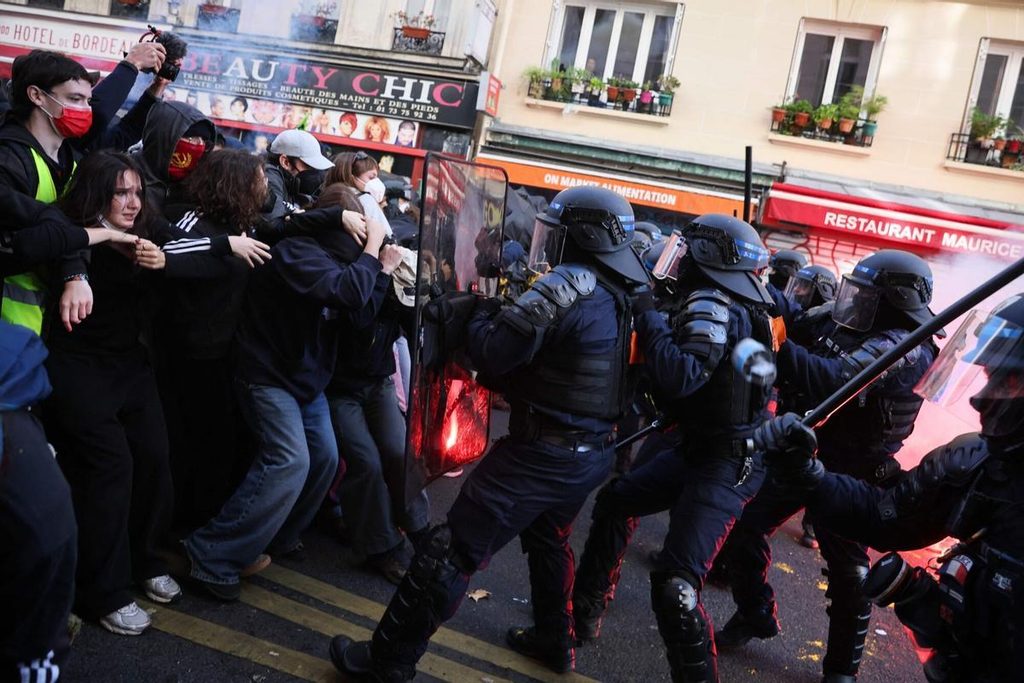
From France to Albania, from Belgium to Turin, the protests of these days stage a clash between metaphors. Young people (the people) and police officers (the State), equally precarious, face each other as if the other were the enemy. But the enemy stopped living where we look for it long ago. And that is precisely where it organizes the anger, makes it visible and summons it into the street.
Let me say this right away, to leave no room for misunderstanding: the young people who have been filling the streets of Europe in recent weeks have every right to do so. This is not a rhetorical concession, one of those premises you write only to take back three lines later. They have reasons to spare: schools falling apart, overcrowded classrooms, a future shrinking like a room whose walls someone moves at night while we sleep. Anyone who dismisses them as vandals, as spoiled children of a prosperity they no longer know, or as puppets of some hidden director, has understood nothing. Or pretends not to understand, which is worse. But precisely because they are right, and precisely because their distress is real, it is worth asking the question nobody seems willing to ask these weeks. Not because it is difficult, but because it is uncomfortable for everyone: for governments, for movements, for newspapers, for commentators. The question is simple. Against whom are they protesting? In favor of what?
There is no point asking against what. The what is clear, even too clear: the cuts, the cost of living, the decrees, the war that swallows resources, the idea that school should serve the labor market rather than people, impossible rents. But where does the power that produces all this live, if it lives anywhere at all? Because a protest without an addressee is not an absence of politics: it is a politics someone else is doing in your place, using your body, your time, your anger.
I. The scene: a Europe that always ends up in the same frame
Let us look at the images before interpreting them. In France the mobilization began in September in Brittany, in the schools, against staff shortages and the decay of public education, and spread across the whole country. On October 6, according to the Interior Ministry, more than 250,000 people were in the streets; according to the organizers, almost twice that. The toll of weeks of protest runs to thousands of arrests and hundreds injured, among students, teachers and officers. In Lens a fifteen-year-old boy lost a hand after coming into contact with a police grenade. In Brussels, on October 9, unions striking against budget cuts were joined by hundreds of students inspired by what was happening in France. A few dozen masked protesters threw stones at the police; the police responded with tear gas and water cannons; twenty-one people were detained, thirteen of them minors. In Albania, the student protest outside the Ministry of Education on October 13 turned within hours into a revolt against the Rama government: the Ministry of Justice in flames, attacks on public buildings, banks and businesses, 89 injured, 61 of them officers.
And then Italy. On October 16 thousands of students marched in every city against the school decree, the cap on foreign pupils in classrooms, the 4+2 model for technical institutes, the cost of living, military spending. In Milan, a river of second-generation young people, born here or arrived as children, forming a shield against those who would like to count them. In Rome, bottles and firecrackers outside the ministry. In Bologna, shields in front of the station. In Turin, stones against officers, water cannons against students, and in between some teachers who placed themselves between the two lines, as their French colleagues had done a few days earlier. You don’t need to be a sociologist to notice that the causes are different, and so are the contexts, and yet the final frame is always the same. A kid in a hood facing a kid in a helmet. The protest is born against something enormous and undefined, a social model, a stolen future, a politics that does not listen. And it ends, with almost mechanical regularity, in hand-to-hand combat between two people who have never met and have no personal reason to hate each other.
This frame is the real political subject under discussion today. Not because the clash is the heart of the matter: on the contrary, I argue that it is peripheral. But because that frame is a symptom, in the precise sense the word has in psychoanalysis: a compromise formation that shows and hides at the same time. It shows that there is a conflict. It hides who is really party to it. And the media, who love that frame because it brings in viewers, only amplify its function as a screen. Even the mayor of Turin said so, with unexpected lucidity: there are those who use those images to talk only about the clashes, leaving the problems the young people raise in the background.
II. Two metaphors facing each other in a mirror
Let us return to those two bodies. The student in the street is a metaphor: he stands for a generation whose future has been taken away, for a school turned into the antechamber of employment, for an existence that discovers itself precarious before it has even begun. But the police officer is a metaphor too. In fact, if you look closely, he embodies it even better. He is often young as well, almost always from the peripheries and the South, poorly paid for a hellish job that asks him to stand for hours under a hail of bottles to defend a ministry whose minister he will never meet. He too has watched his future shrink; he too is the product of a social model that offers a uniform as the only possible stability. The difference between the two is not one of class. It is one of position: one has been put in front, the other behind a shield.
Pier Paolo Pasolini understood this in 1968 when, after the clashes at Valle Giulia, he wrote that his sympathies lay with the police officers, sons of the poor, and not with the students, children of the bourgeoisie. It was a heresy, and he was treated as a reactionary (and hardly anyone has ever read how that line continues, something Ascanio Celestini does very well in his new book on Pasolini). But Pasolini’s gesture was not a defense of the police: it was an attempt to shift the gaze from the choreography to the structure, to remind us that within that clash stood bodies socially closer than the flags let on. Today that intuition has become even truer, and at the same time more tragic. Truer, because the social distance between the student and the officer has narrowed further: the kids in the streets of Milan are the children of workers, migrants, precarious laborers. More tragic, because in the meantime the master those officers once shielded has disappeared. In 1968 behind the cordon there was still the State, there was the bourgeoisie, there was an enemy with an address. Today behind the cordon there is a palace often empty of real power.
Hegel, in the Phenomenology of Spirit, describes the struggle for recognition as the moment when two self-consciousnesses confront each other at the risk of their lives, and from which the relationship between master and servant arises. The decisive point, the one Alexandre Kojève would make famous in his Paris lectures, is that the struggle only makes sense if there is a master by whom to be recognized. But what happens when the struggle takes place between two servants? When both contenders seek recognition from a third party who is not present, and who has no interest in recognizing anyone? The dialectic jams. There is no synthesis, no overcoming, no history. There is only repetition: the same scene, every week, in a different city.
René Girard gave this mechanism a name. In Violence and the Sacred and then in The Scapegoat, Girard shows how communities in crisis discharge accumulated violence onto a substitute victim, who is not the cause of the crisis but becomes its symbol. The sacrifice solves nothing, but it temporarily restores order: the violence is discharged, the tension drops, everything can start again as before. The street clash works exactly like this, and it works in both directions. For the student, the police officer is the scapegoat of the system: striking him is symbolically striking power. For the State, and for the public reading the next day’s papers, the violent student is the scapegoat of disorder: punishing him reaffirms order. Each sacrifices the other. No one touches the cause.
That is why I speak of a clash between metaphors. Not to diminish the pain, which is all too real: the hand lost in Lens is no figure of speech, nor are the 61 officers injured in Tirana. But because what confronts itself in those streets is not the subjects of the conflict but their representations. Two figures of distress set against each other, each convinced the other is the obstacle. And while they stare into each other’s eyes, neither looks up from the screen.
III. Power has changed address
If we look up, what do we see? We see that what is at stake in the streets of Paris, Tirana, Brussels, Madrid and Turin is no longer, or no longer only, a matter of States. Local governments, with their budgets and decrees, are the visible target: the one you can name in a slogan, the one outside whose ministry a march can stop. But the organization of society that produces the distress now has little to do with ministries. Governments administer ever-narrower margins within constraints decided elsewhere: by the financial markets that rate the debt, by the platforms that control the infrastructure of information, by the large corporations that decide where to move capital, production, labor.
Michel Foucault, back in the 1970s, taught us to distrust the idea that power resides in a place. Power, he wrote, is not a thing one possesses; it is a network of relations running through bodies, institutions, forms of knowledge. It is not at the top of the pyramid; it is everywhere. But Foucault was still thinking of disciplinary institutions: the school, the barracks, the factory, the prison. Closed places, with walls and timetables, where power shaped individuals. Gilles Deleuze, in a short 1990 text that now reads like a prophecy, the Postscript on the Societies of Control, had already announced the end of that model. Disciplinary societies, he said, are giving way to societies of control, in which power no longer confines but modulates, no longer watches within an enclosure but follows everywhere, continuously and without boundaries. Man, Deleuze observed, is no longer man enclosed but man in debt. And he added a detail that sounds chilling today: in the society of control, school would be replaced by lifelong training, and the corporation would take the factory’s place as the soul of the system. Reread that text thinking of the 4+2 model, of work-study schemes, of school as one segment in a human-capital supply chain, and you realize that this autumn’s students are protesting precisely against what Deleuze described. But they do so with the tools of another era: the march, the occupation, the siege of the ministry. Tools designed for a power that had a center, a palace, a door to break down. Control power, by contrast, has no doors. You cannot besiege it, because it is nowhere.
Michael Hardt and Antonio Negri (who knows how pleased he would have been today), in Empire, described this form of sovereignty as a decentered and deterritorializing apparatus, with no territorial center and no fixed boundaries. One can argue at length about their political conclusions, but the diagnosis stands: sovereignty no longer coincides with the nation-state. Power has evaporated into the global space of flows, while politics has remained local. Power without politics on one side, politics without power on the other. In between, the streets. And here we understand why the young people’s anger, even when it finds a precise target, such as the Italian decree or the Rama government, always ends up seeming a little disproportionate, a little out of focus. Not because it is unjustified, but because the addressee is not equal to the message. A minister is being asked to give back a future it is not in his power to give back. A national government is being asked to reverse processes that national governments have, for decades, merely managed. The street shouts at the palace, but the palace is only the switchboard of a power that answers from another number. The ministry, in this scene, is as much a metaphor as the student and the police officer: it is the visible face of decisions it does not make.
IV. The paradox of the medium: what moves you is what you are fighting
There is, however, something deeper, and more disturbing, than the simple evaporation of power upward. And it is the real news of this autumn, the news no newscast will report. The protests are organized on the very platforms that embody the power they protest against. The chats where the meeting point is decided, the social networks that call for mobilization, the algorithms that circulate videos of the clashes: these are all private infrastructures, owned by a few corporations, fueled by an economic model that lives on attention, data, conflict. What moves the young people and what they would like to fight coincide. The medium of the revolt is its target.
Marshall McLuhan put it in a phrase that has become a cliché and that, for this very reason, no one takes seriously anymore: the medium is the message. What matters is not only what is said, but through what it is said, because the medium alters the very form of experience. A protest organized on a platform is not the same as a protest organized in an assembly. It inherits the platform’s grammar: speed, fragmentation, the hunt for the image, polarization. Above all it inherits its economic logic. Every shared video of clashes is monetized attention. Every call to mobilize is a data point. Every expression of rage online is engagement. The platform is not neutral toward the conflict: it lives off it. And it has every interest in the conflict taking its most spectacular form, namely physical confrontation, because that is what generates the most views.
It is a telling detail that in France a fact-checking organization identified fake videos circulated to inflate the chaos and violence of the protests. It does not matter here who produced them. What matters is that the ecosystem rewards them. Guy Debord, in The Society of the Spectacle, wrote that the spectacle is not a collection of images but a social relationship between people mediated by images. And there it is: today’s street is exactly that. A social relationship, the one between the student and the police officer, entirely mediated by the images that will be drawn from it. People take to the streets partly to be seen, and they are seen only if the clash happens. The spectacle has absorbed the contestation of the spectacle, as Debord feared and as the Situationists, in the end, could not prevent.
Byung-Chul Han added a decisive piece. In Psychopolitics he observes that contemporary power does not repress freedom; it exploits it. It does not force us to be silent; it encourages us to speak, to express ourselves, to share. It is a seductive power, working through our desire rather than against it. That is why, Han says, it is so hard to rebel: because rebellion itself becomes a form of participation in the system. Shoshana Zuboff, in The Age of Surveillance Capitalism, gave this mechanism a precise economic anatomy: human experience turned into free raw material, extracted, analyzed and resold as behavioral prediction. The anger of a generation is an extraordinary mine of behavioral data. And it is extracted as it is being expressed.
The result is a paradox reminiscent of the knot in certain ancient myths, where the hero flees his fate and, by fleeing, fulfills it. The young people are fighting a model of society governed by financial and digital flows, using those very flows as their only means of organization. This is not a fault, not naivety: it is the condition of anyone living today. There is no available outside, no uncontaminated place from which to organize resistance. But precisely for this reason it should be named. Because as long as it goes unnamed, that paradox works in silence, and it always works in the same direction: it turns protest into content, content into clashes, clashes into ratings. And power, the real one, thanks you for your cooperation.
V. Simulacra of struggle
All this leads to a conclusion that must be stated carefully, because it is easy to misread. This autumn’s struggles risk becoming simulacra. Not in the sense that they are fake: the pain is real, the reasons are real, the bruises are real. But in the precise sense Jean Baudrillard gave the word. In Simulacra and Simulation Baudrillard describes a sequence: first the image reflects a reality, then it masks it, then it masks its absence, and finally it bears no relation to any reality whatsoever and is its own pure simulacrum. The street clash passes through every one of these phases. At first it represents a real conflict, between a generation and a social model. Then it masks it, because it replaces it with another conflict, between students and police. Then it masks its absence, because the real adversary is not present and the scene serves to make us believe it is. Finally it becomes autonomous: people take to the streets for the clash, the clash produces images, the images produce the next protest.
Baudrillard wrote a provocative book titled The Gulf War Did Not Take Place. Obviously he did not deny the bombs and the dead. He argued that what the Western public had seen was not a war but its televised simulation, an event built to be watched. One could write an equally provocative book today: the revolt is not taking place. Not because there are no people in the streets, but because the event we call revolt is increasingly its own representation, a coded sequence of gestures, slogans, images and reactions everyone knows in advance. The minister will say the violence is unacceptable; the opposition will say the young people must be listened to; the police union will demand more protection; the papers will headline the clashes. And the next day nothing structural will have changed.
Mark Fisher, in Capitalist Realism, described the condition of a generation for whom it is easier to imagine the end of the world than the end of capitalism. Fisher’s point was not that capitalism was invincible, but that it had colonized the imagination to the point of making any alternative unthinkable. Protest too, in this picture, is precoded: there is a space set aside for dissent, a format, a genre, with its own rules and outcomes. Fisher spoke of gestural anti-capitalism: critique of the system expressed as style, as pose, without touching the mechanisms. I am not saying the young people of Turin or Paris are posing. I am saying the system they move within has already anticipated their anger and prepared a stage for it.
The enormous political problem today is that the individual can no longer represent to himself the totality of the system he lives in. Global capitalism is too vast, too abstract, too distributed for anyone to draw its map and locate themselves within it. Without that map, political action is blind: you strike what you see, not what matters. The police officer is visible. The ministry is visible. The capital flow that decided a school’s closure, the algorithm that decided which protest to show and which not, the investment fund that owns the platform on which the protest was called: these cannot be seen. And what cannot be seen cannot be fought. This is the heart of the simulacrum: the struggle takes place between sections of the population equally in distress, while the distress itself is produced elsewhere. The student who will never have a pension and the officer who barely makes it to the end of the month. The precarious teacher who steps in to protect his pupils and the shopkeeper whose window is smashed. The second-generation immigrant marching against the cap on foreigners and the pensioner watching him fearfully from the window. All in difficulty, all convinced they have the problem in front of them. None of them truly in a position to solve it.
VI. Infiltrators, clashes, legitimacy: the wrong questions
I already know what objections will come, because they are the same ones repeated every hot autumn. There are infiltrators, professional troublemakers, those who in Turin seemed a little too old to be students. According to the Albanian police, of the dozens detained after the Tirana clashes only a few were students. The police, on the other side, use disproportionate force, and human rights organizations have been denouncing it in France for weeks. Burning a ministry is not legitimate; or it is, if the ministry is deaf. Throwing a stone is violence; or it is the response to a greater, structural, invisible violence.
These are serious discussions, and I do not intend to dismiss them. Twentieth-century political philosophy left us refined tools for tackling them. Walter Benjamin, in his Critique of Violence, distinguished between law-making and law-preserving violence, and showed how every legal order is born of a violence it then forgets. Hannah Arendt, in On Violence, argued the opposite: that violence and power are opposites; where power is real, that is, grounded in consent and acting in concert, violence is unnecessary; violence appears where power is waning, and it can destroy power but never create it. Frantz Fanon, in The Wretched of the Earth, saw in the violence of the colonized a moment of detoxification, a way of reclaiming a denied subjectivity. These are three incompatible positions, and each illuminates something.
But it is Arendt who gives us the key to understanding why these questions are secondary today. If violence appears where power is waning, then the violence in these streets is the sign of a power vacuum. Not of an excess of state power, as those throwing stones believe. Not of an excess of youthful disorder, as those repressing them believe. But of a vacuum: real power, the power that decides, is not present, and the two bodies left in the street collide because they have nothing else to hit. Street violence is the shape politics takes when politics no longer has an interlocutor.
That is why the debate over who is infiltrating, over how far it is acceptable to make use of a mobilization that destroys everything, over what the acceptable threshold of force might be, is a debate about the choreography, not the music. Every hour spent establishing who threw the first stone is an hour not spent talking about where the money missing from schools ends up. Every editorial on student violence, or on police brutality, is one editorial fewer on who owns the infrastructures through which we think, on what form of life we are accepting without ever having chosen it. I am not saying those questions should not be asked. I am saying they are the questions the system prefers us to ask, because they keep us busy arguing about the perimeter while the center remains intact.
There is, indeed, a suspicion worth formulating, even if it cannot be proven. Street violence benefits everyone except those who suffer it. It benefits governments, which can shift the conversation from the reasons for the protest to security. It benefits the most radical groups, which gain visibility. It benefits the media, which gain viewers. It benefits the platforms, which gain traffic. It does not benefit the students, who see their reasons buried under the images. It does not benefit the police officers, who risk their bodies for a miserable salary. An economy of violence in which the gains are distributed at the top and the costs at the bottom: is that not the most precise definition of the system being protested against?
VII. The enemy exists, and it is shared
Carl Schmitt identified the distinction between friend and enemy as the very criterion of the political. To do politics, for Schmitt, means being able to name the enemy. It is a dangerous thesis, one that has justified horrors, and I do not propose it as a model. But it contains a truth that today’s streets make evident by contrast: whoever cannot name their enemy does not do politics, they endure it. And whoever gets the enemy wrong is doing someone else’s politics. The student who sees the police officer as the enemy, and the police officer who sees the student as the enemy, are both applying Schmitt’s criterion in the worst possible way: they have identified their own kind as the enemy.
The enemy exists. It is shared: shared by students and police officers, by the teachers who step in between and the parents watching the news, by the second-generation kids of Milan and the pensioners who fear them. It is an organization of society founded on extraction: of value from labor, of data from lives, of attention from emotions, of future from the generations to come. It has no face, because it is made of flows. It has no headquarters, because it is distributed. It has no name, because every name we give it, finance, platforms, corporations, capital, captures only one aspect. But it has precise, measurable effects that the young people in the streets know very well: collapsing schools, impossible rents, fixed-term contracts, a climate in collapse. The enemy, then, is not in those streets. It is what sends you into those streets. It is what organizes your anger, lays it out, makes it go viral, turns it into content and then channels it into the one outlet that costs it nothing: having you tear each other apart. While, outside the frame, the world crumbles, work dissolves, school becomes a supply chain, and those who profit from all this have never needed to put on a helmet or a balaclava.
This is not an invitation to stay home. That would be the most convenient advice for the system I have described, and the most unjust toward young people who are right. It is an invitation to protest better. To turn the street from a stage into a place of thought: assemblies, inquiries, maps of power drawn together. To seek unexpected alliances, even with those on the other side of the shield, who have a union, a salary and a child attending the same crumbling school. To hold governments to account, of course, but also those above them: the platforms, the funds, the supranational institutions that decide without ever setting foot in the street. And not to forget that the phone you use to organize the next march also belongs to someone: try disconnecting all at once, all of you, stop posting and go back somewhere else, and see how suddenly everything would collapse.
Source: Autonomies