

An echo of “One, two… a thousand Vietnams”, which we used to shout at some Parisian demonstrations back in ’68
Tomás Ibáñez (18th of October 2026)
from Redes Libertarias 20/10/2026
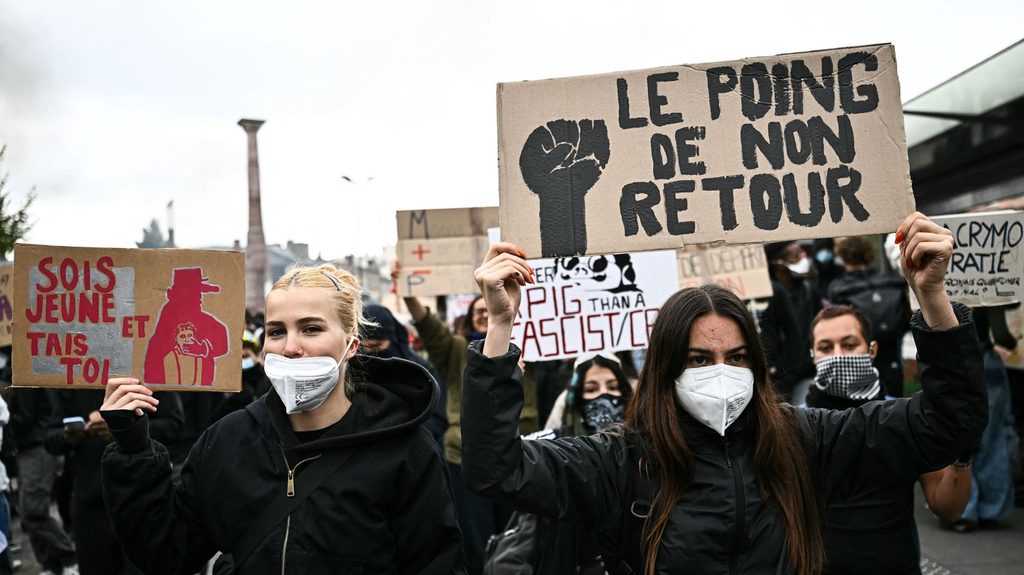
The intense events of 17 October, with their long list of violent clashes in many French cities, show that France could not be an exception. Just as has happened in recent years in many regions of the world – from the Americas to South-East Asia, via several European countries – we have witnessed on this occasion an outburst of discontent that had been slowly building up, with hundreds of thousands of people taking to the streets and showing a determination capable of withstanding even the most forceful police crackdowns. As in so many other countries, the people who fuelled the demonstrations on this 17th of October did not do so by obeying slogans issued by large organisations, but primarily through social media, through everyday conversations circulating within the social fabric of neighbourhoods and workplaces, and also in response to calls from small organisations, without any centralising body acting as an intermediary between them.
It turns out that the absence of structures to organise and direct the demonstrations lends them a certain air of self-organisation, leaving decisions to those directly involved in the protests, spurring their creativity, and making them the protagonists of the actions undertaken. It is clear that they are not fighting to advance some supposed revolutionary project. However, they are engaging in practices that are revolutionary in the here and now because, by confronting the tremendous force of the system that their mobilisation is challenging, they are creating a climate of dissent whose short- and medium-term consequences are difficult to predict.
The international proliferation of events such as those of the 17th of October in France bears witness to the validity of those viewpoints which maintain that wherever domination tightens its grip, resistance inevitably emerges and revolt breaks out. Such views therefore predict that large-scale mobilisations will erupt sporadically, and with an apparently spontaneous character, in places where local circumstances of oppression ignite the sparks of insurrection, in some cases leading to a ripple effect in other places, but without these outbursts being the product of grand emancipatory narratives.
As is customary when the roar of discontent takes to the streets, the media prioritise the most spectacular images, which are usually those of pitched battles, fires and attacks on objects that in some way symbolise the instruments of oppression. This, combined with the comments of those in power and defenders of the established order, provokes fear and rejection amongst a large section of the population. And, as is also customary, the political parties and groups that more or less explicitly support the uprisings are quick to express their condemnation of actions labelled “violent”, when they do not go so far as to attribute them to deliberate provocations. This is what Mélenchon, for example, the leader of the party situated to the left of the Socialist Party and aligned with the Frente Amplio operating on this side of the Pyrenees, has done. If such actions occur during the protests taking place ahead of the 29 November elections, we will need to keep a close eye on how the leadership of the Frente Amplio reacts, as well as the organisations backing these strikes and protests.
It has been several years now since the peak of the “Yellow Vests” movement came to an end, but that symbol has made its mark – without quite turning them yellow – on demonstrations in various cities, and this highlights one of the most valuable outcomes of intense collective struggles: they act as a catalyst for raising awareness and, in a matter of days, forge activists who will remain so until their dying breath. Creating long-lasting, defiant and subversive subjectivities is the precious outcome of radical collective struggles, whatever their outcome may be; not to rejoice in the ferocity of the clashes and the brilliance of the flames, but to denounce them, is to do a disservice to the creation of that flow of forces of resistance to the established system that is born of the struggle.
Source: Autonomies