
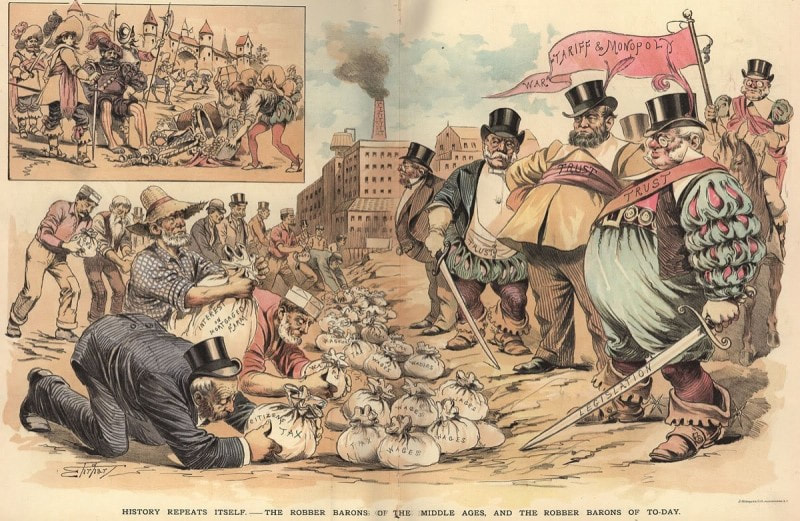
Both the Wall Street Journal and the New York Times recently published pieces suggesting a growing group of Americans “have lost faith in both parties” or “hate both parties”.
If Americans have such a low opinion of the two major parties, if neither party represents us, or reflects our views, then why doesn’t the system change? Why do Americans of all demographics and supposed political stripes defend the political status quo they say they hate.
The ideas of System Justification Theory (SJT) attempt to confront the paradox of the exploited justifying their own exploitation. They help us understand how our deep desires for stability and meaning are actively manipulated to keep us docile. SJT offers a model of the psychological mechanism that explains why objective material interests so often fail to produce class consciousness and political change.
Introduced by John T. Jost and Mahzarin R. Banaji, SJT suggests that people have a fundamental psychological need to see the society they live in as essentially legitimate and just. These beliefs help people manage existential uncertainty and process social disruptions, offering a sense of stability. SJT’s core prediction is that people will rationalise and defend the prevailing political and economic system even when doing so runs contrary to their own interests.
The research shows a disturbing pattern of out-group favouritism, whereby members of a lower-status group will praise the high-status group and reflect on its superiority. SJT predicts that when people understand a social system to be stable or inescapable, they will rationalise inequalities as deserved, necessary, or essentially fair.
The studies have shown “that system-justifying variables increase ingroup ambivalence among low status group members and decrease ambivalence among high status group members.” Social and economic precarity therefore preserve themselves in a way. Experimental results show that, other things being equal, the temporary activation of existential needs or factors (like the presence or awareness of a threat or of uncertainty or mortality) increases the attractiveness of system-justifying and right-wing views.
When members of low-status groups declare their approval of the system, along with its fairness and legitimacy, there is a kind of psychological injury. If we take these insights seriously, we may see the struggle against system legitimacy as an intervention in subjectivity. This means that organising and activism must also address the need for the healing and repair of identity. Our interventions need to acknowledge that our political and economic system is insane and crazy-making, as Jost pointed out in an interview.
SJT shows that we desperately want to believe the world is fair, and we will bury our heads in the sand to preserve that picture. A study earlier this year even applied SJT to explain employees’ enthusiasm for an AI system being used to monitor their performance and productivity. Relatedly, recent research also uses the theory “to argue that AI systems may function as ‘moral cover’, allowing users to perpetuate inequality while maintaining beliefs in their own objectivity.”
The need to cling to false, system-justifying ideas and beliefs helps explain why it’s so hard to change society: subjects’ system-justifying beliefs are holding them together psychologically. Anti-authoritarians should focus on the strategy of targeting the apparent psychological need to justify the system by creating and holding out new ways to meet people’s epistemic, existential, and relational needs.
Subscribe to Freedom anarchist journal, sustain radical publishing and support independent media.

£25.00


£12.99

£29.99

£13.99


£20.99


£28.99

£12.99

£22.50

£23.00



£24.99

£29.99


Freedom
Bookshop
The shop will be closed on Sunday 18 October
Angel Alley 84b Whitechapel High St London E1 7QX
Opening hours: 12pm to 6pm (Mon-Sat), 12pm to 4pm (Sun)



£9.00


£15.00


£1.95


£5.00


£8.00


£5.00


Original price was: £4.95.£2.50Current price is: £2.50.

£10.00


£1.00

£7.50


£5.00


Browse 140 years of anarchist commentary and reporting from the Freedom digital archive
EXPLORE THE
Archives
Latest

“Our drummer went to the jungle to fight the junta”
Interview: The Rebel Riot lead singer Kyaw Kyaw talks about his discovery of punk music and experiences of political upheaval in Myanmar

£14.99

£12.99


£25.00

£14.99


£15.00

£19.00


£45.00

£4.00

£4.50

Source: freedomnews