
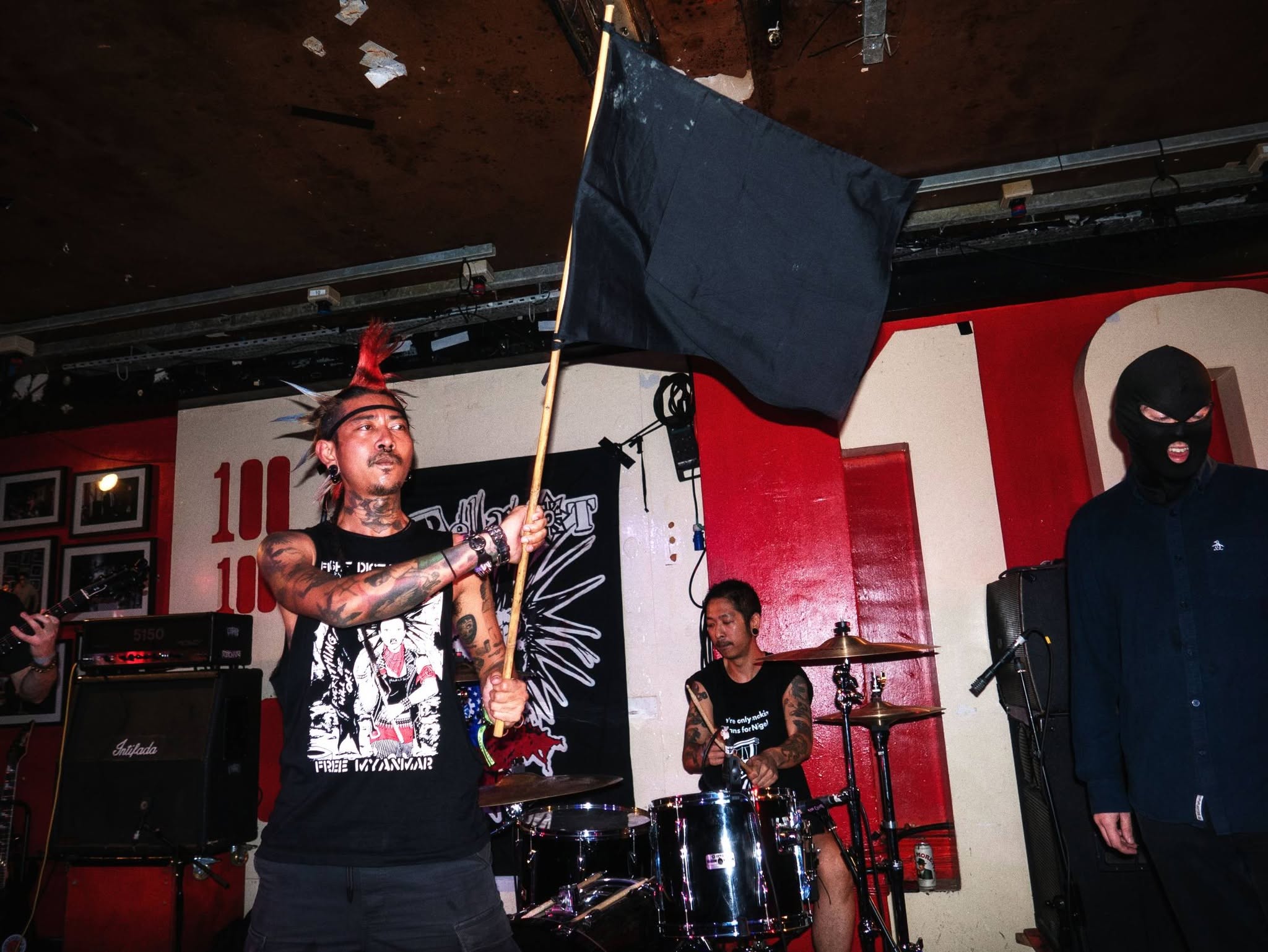

Watching The Rebel Riot, at the Manchester Punk Festival last year was a chaotically cathartic experience.
Kyaw Kyaw screamed this throat out during the band’s thrashy, three-minute blasts, railing against Myanmar’s military junta, the Gaza and Rohingya genocides, rise of fascism, and latest Middle East war.
The band is made up of Kyaw Kyaw on vocals, fellow Burmese punks Shane and Si Soe on bass and drums, with Lukas, from Croatia, on guitar.
“We started in 2007 during the Saffron Revolution,” Kyaw Kyaw says.
Burma/Myanmar’s history since it gained independence from the British in 1948 is bloody and complicated. The military ruled from 1962-2011, when reforms eventually brought liberal cause celebre Aung San Suu Kyi to power in 2016.
It was during the Nobel Peace Prize winner’s tenure that the Rohingya genocide began in 2017. Villages were burned, thousands killed, and hundreds of thousands more forced to flee the country. No-one has been held accountable or faced anything like (what states consider to be) justice.
Then, in November 2020, the military faction lost to Suu Kyi’s party in a general election. Ever the sore losers, they launched another coup in February 2021.
The various peoples of Burma have not taken this oppression lying down. They have rebelled countless times. The Saffron Revolution being just one case.
“A lot of Buddhist monks demonstrated against the military junta at that time,” Kyaw Kyaw says.
“Everybody believed the junta respected the monks because they promoted Buddhism. ‘They won’t kill the monks’.”
This was Kyaw Kyaw’s first protest. He was in his early 20s and “didn’t know anything about politics,” he says.
“I only knew one thing: the military system is not good, lots of people are getting poor, and we cannot speak freely.
“After two days of protests, the military started shooting people, even the monks.
“Lots of people were killed in front of me. I was so scared, I ran away.
“After this, me and my friends said, ‘Hey, what can we do? I hate them. We should do something’. So, we created a band.”
The band changed its members a few times, but Kyaw Kyaw remained. Between 2011 and 2024 he also helped organise Yangon’s DIY punk scene, ran a community food project and became a social activist.
“I didn’t know anything about anarchy,” Kyaw Kyaw says. “But, I learnt about it through punk music. The lyrics were my education. I thought anarchy was just about chaos, that it meant we do whatever we want, ‘fuck the police’, stuff like that.”
Crass, perhaps anarcho-punk’s most illustrious band, opened his eyes to what anarchism is really about.
“I also had some activist friends, and I learnt from them. We based Food Not Bombs on anarchist principles.”
Buddhism also played a pivotal role in his worldview. It taught him to meditate and seek inner peace. He says he tries to mix anarchist, punk and buddhist philosophies in his daily life.

“Authoritarianism and fascism are not only outside of us,” he tells me. “They are also inside us, you know. You have to fight your own police,” he says, tapping the side of his head.
Everything changed after the 2021 coup.
“Our drummer went to the jungle to fight the junta, like Che Guevara. Our bassist, he didn’t feel safe anymore, and he moved to Thailand. Then our guitarist passed away from a heart condition.”
Kyaw Kyaw managed to find new band members, but in time, they too were forced to flee, as was he.
“In 2024, the military started arresting people every day. I was lucky. I was not on their radar yet. But after three-and-a-half years, my mental health had deteriorated. Some of my friends were in prison, some fled the country, some were dead.
“Every night, the military were going house to house, knocking on doors and arresting young people.”
Kyaw Kyaw’s luck held. He managed to fly out hassle free, more or less.
“I left early in the morning, because I knew the police at the airport would be sleepy. I got to the airport and the police, they looked at me a little weirdly. ‘Ah, you’re a punk’ they said, and they wanted to take selfies with me. I was put on the police’s list two months after I left.”
I ask Kyaw Kyaw what’s next?
As for the band, he says it’s kind of up in the air, with some summer gigs in Europe. As for future, “I feel a little negative,” he says. “But I stay hopeful. Hope is the answer. Otherwise, we can’t do anything.
“We should practice what they don’t have. They don’t have love, kindness or mutual aid. They don’t have the compassion.“
This article was first published in the Summer 2006 edition of Freedom anarchist journal. More from Ben at The Civil Fleet newsblog and podcast.
Subscribe to Freedom anarchist journal, sustain radical publishing and support independent media.

£14.99

£16.99

£19.99

£20.00


£16.00

£10.00

£9.95


£3.50

£9.99

£25.00

£15.00


£16.99


£14.00

£20.00
Freedom
Bookshop
The shop will be closed on Sunday 18 October
Angel Alley 84b Whitechapel High St London E1 7QX
Opening hours: 12pm to 6pm (Mon-Sat), 12pm to 4pm (Sun)



£9.00


£15.00


£5.00


£8.00


£5.00


Original price was: £4.95.£2.50Current price is: £2.50.

£10.00


£1.00

£7.50


£5.00


Browse over a century of anarchist commentary and reporting from the Freedom digital archive
EXPLORE THE
Archives
Latest

French student revolt reaches Argentina
Anarchist News Review: Talking more on France and the spread of radical student protests across Europe, with special guest Ben in Montpellier

Lesnes Estate: Block party against demolition
In Thamesmead, the threat of “redevelopment” meets resistance, community and a little anarchist chaos

£14.99

£12.99


£25.00

£14.99


£15.00

£19.00


£45.00

£4.00

£4.50

Source: freedomnews