

Postcard from Montpellier
I’ve become more politically engaged through the years that followed and so, when the Freedom crew were recently bemoaning a lack of direct links between the UK and the French scenes, I thought I ought to do my bit to provide a bit of cross-Channel cross-pollination.
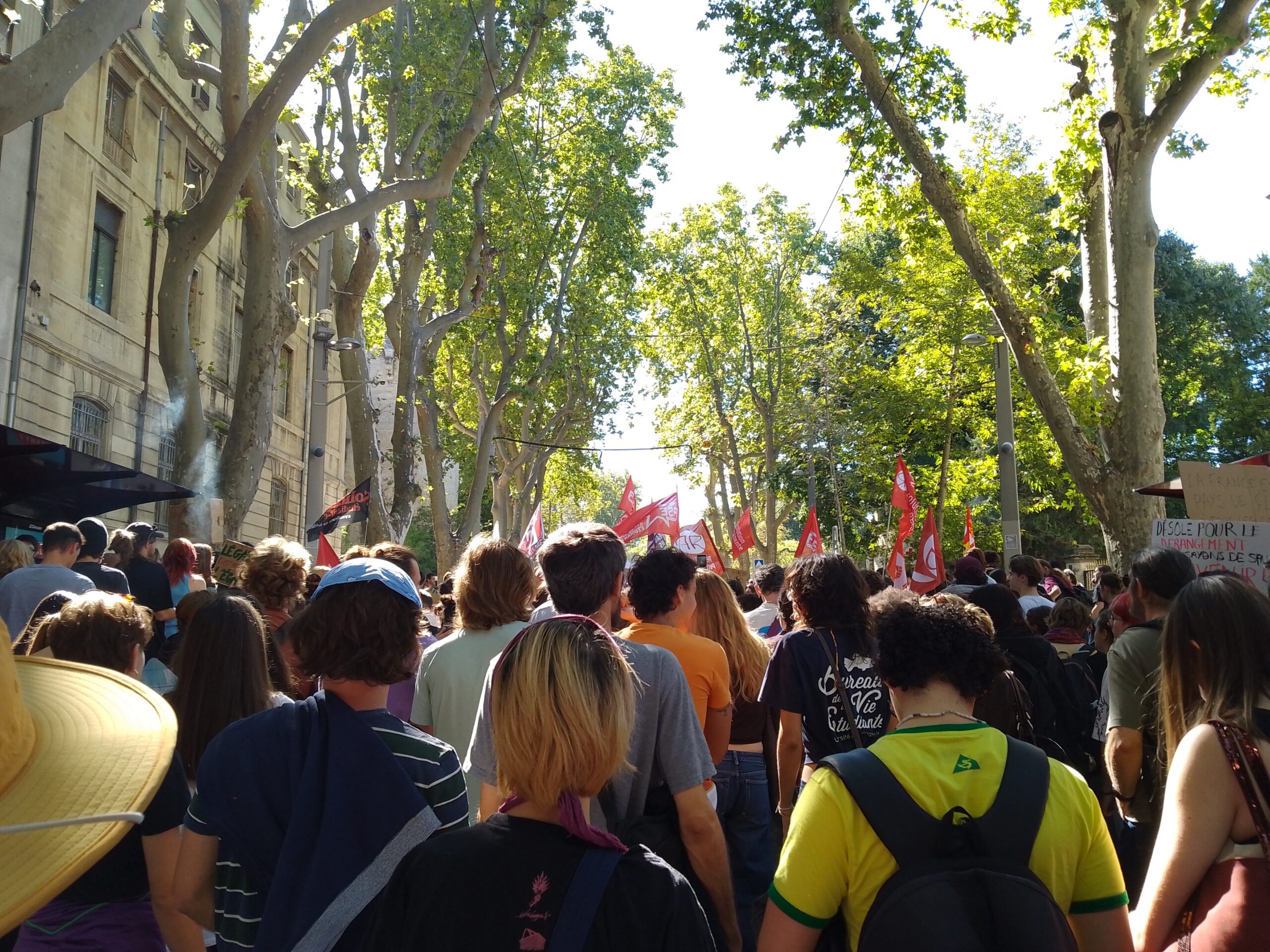
The whole of France effectively runs on the academic calendar, and we have just entered the return-to-school period (la rentrée). Every year so far, this has been the peak time for protests: in 2024 it was a huge antifascist march in the run-up to the elections; last year it was the decentralised social media-organised Bloquons Tout movement (though an attempted follow-up flopped); and this year, it’s the lycéen·ne·s (i.e., college students and Sixth Formers). These are just the major events that reliably bring out 7,000–11,000 people; there are other, smaller marches just about every weekend. When I first arrived I went on a tour of the city centre, but lost the group amidst a huge protest in front of the Préfecture. I circled the building to try and find my group, and found another, unrelated farmers’ protest on the other side. It was a Saturday, so I’m not even sure anyone was in.
The French are well aware that it only takes a small number of people, strategically placed, to cause outsized disruption. Famously, Haussmann widened the streets of Paris in part to make them harder to blockade; in Montpellier, only one street was so designed before the designers ran out of money, leaving the old centre of Écusson a tangled mess of narrow, winding streets. Protests rarely enter there (it’s usually declared off-limits by the Préfecture), but if they ever did it would prove remarkably unfavourable terrain for the forces of order. Instead, marches usually circumabulate the centre, around which all of the tramways are centralised.
However, as long as these protest movements remain somewhat siloed into ‘left’ or ‘right’ or ‘pro-Palestine’ or whatever, the state can generally keep things under control. Over the last couple years they’ve sacrificed a few prime ministers to appease the crowd (although, bizarrely, last year Macron just reappointed the same guy, who remains in post to this day), but so far waiting for the momentum to die out and crushing particularly obstinate holdouts with riot police seems to have worked out. What the French state really fears, though, is a confluence of struggle. This is what happened in the Gilets Jaunes protests, where anger over cost of living united people across normal political divides and (crucially) social class. The result was the greatest threat posed to the Fifth Republic since May ‘68; there was one point where helicopters were being prepared to evacuate Macron from the Elysée palace. That confluence seems to be what is happening again today.
When we talk of the French police as ‘militarised’, it conjures US-centric images of a police force given access to all sorts of military tools and gradually becoming a holding pen for people too violent for airsoft, yet too incompetent for the military. But in France, a major component of their riot control force is the Gendarmerie mobile, part of the Armed Forces; in the French case, then, it’s perhaps more accurate to call them policified soldiers.
Whether civilian or soldier, what all French cops have in common is a predilection towards violence that exceeds their peers in neighbouring countries. In recent days, National Police armed with assault rifles have been dispatched to schools, and the Municipal Police (roughly equivalent to traffic wardens) have been co-opted into riot control duties for which they are untrained and from which they are normally prohibited. In the past few weeks, teenagers have lost teeth, eyes and hands facing off against the CRS, leading to condemnation from Amnesty International and the UN. Yet the students continue to march, and increasingly their signs (and those of their parents) reference these shocking acts. The students have also clearly been paying attention in history class: last week I saw a sign that read ‘we’ve killed kings for less than this’; and I’ve been seeing more and more references to May ‘68.
 History weighs heavy on the French everyday imaginary. It’s almost like the experience of both the Nazi occupation, and the preceding Vichy collaboration, have left a traumatic impression on the very language itself: one is not a ‘traitor’ in French, but a ‘collabo’; the police are routinely compared to the Vichy-era Milice; and the world ‘rafle’ (roughly ‘police roundup’) is laden with Holocaustic baggage. But equally, you can trace the history of pretty much anything here, from a contemporary newspaper to the French equivalent of HMV, and eventually hit on a connection to the French Resistance (or, the other side). This sense of movement history is also expressed in the remarkably intergenerational membership of many of the marches I’ve been on and groups I’ve participated in. Grandmas here do not retire quiescently; they stand facing our march flipping the double bird and shouting ‘ANTIFA’ at the top of their lungs (true story).
It is hard to overstate how much of a strategic misstep the state’s decision to violently suppress the early student protests has been. Spend any time in the outdoors and one of the first things you learn is that most animals are safe enough, except when they are protecting their young—the sense of ‘mama bear’ energy behind French society’s protective enveloping of their youth is also hard to exaggerate. Teachers have connected their own struggles with that of their students; university students—older brothers and sisters to the lycéen·ne·s both figuratively and, often, literally—shut down 100% of mainland institutions last Tuesday in solidarity; apolitical parents are out in the street en masse to protest the mutilation of their children; farmers in tractors joined school blockades; and the youth uprising has not been limited to only metropolitan France. This all coincides with rolling waves of pre-planned strike action, ranging from public servants to exhausted firefighters (following an unprecedented summer of wildfires). It’s hard to say what will happen next. There were rumblings, even before the lycéen·ne·s seized control of the headlines, that this coming Saturday would mark a new Gilets Jaunes movement, but this seemed to be mostly limited to unsourced AI slop posters shared on social media. But former GJ organisers have urged their supporters to support the students, and so it’s possible that even an originally inorganic movement may provide a point around which these various struggles can converge.
Ultimately it’s hard to see an off-ramp for the state: they have nothing plausible to promise the youth except the excitement of being conscripted to go die in the Balkans. The political centre has thoroughly discredited itself, and next year’s elections are set to be a literal choice between socialism or barbarism. But whilst the left-wing LFI stands to gain the most electorally from this mass mobilisation of young people (many of whom will be voting age come April), and the LFI certainly has a prominent flag-waving presence on these marches, I don’t think the students are content to wait until next year, nor overly convinced that electoral politics are the way to best achieve their demands.
I’ve just come back from my third march in two weeks, as ‘Act V’ of the student protests begins. All I can say for now is that the marches have been larger than I’ve seen before, that they remain so, and that I see little sign that the momentum is slowing.
Source: freedomnews