
La nature exacte de la relation entre Schwarzbard et Nestor Makhno n’a jamais été élucidée. On sait que les deux hommes se fréquentaient à Paris, mais le rôle et l’attitude de Makhno face au projet d’assassinat restent sujets à débat. Certaines sources affirment que Makhno tenta de dissuader Schwarzbard, tandis que d’autres soutiennent qu’il l’y encouragea.
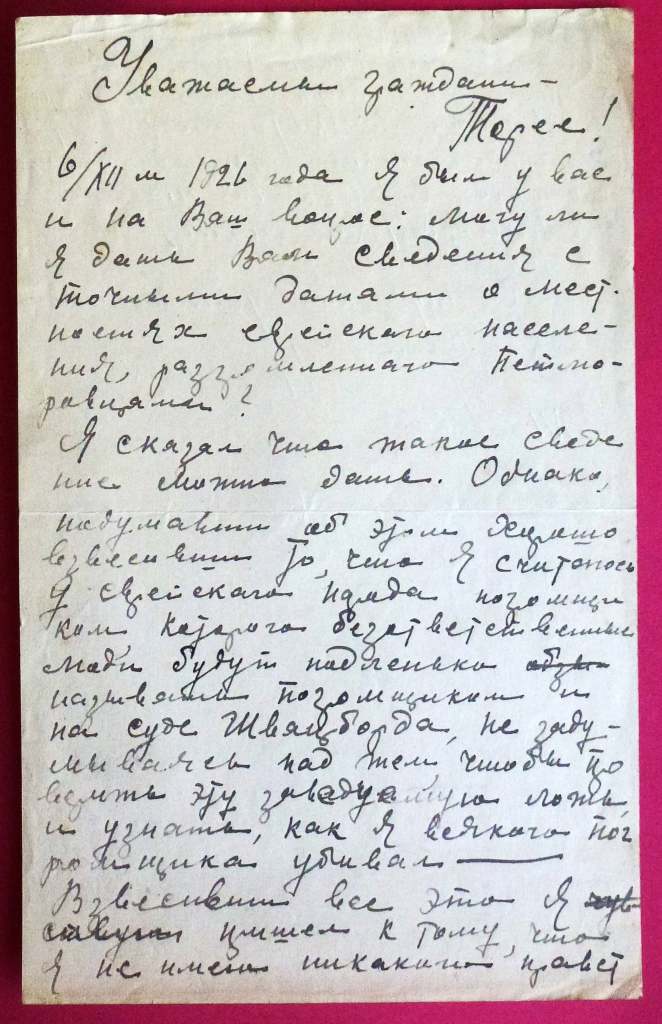
Une source pertinente, mais peu connue, a été mise en ligne en 2021 par la Bibliothèque Maksymovych de Kyiv : deux lettres de Makhno adressées à l’avocat de Schwarzbard, Henri Torres. Elles révèlent que Torres tenta de convaincre Makhno de témoigner en faveur de son client. En décembre 1926, Makhno accepta de témoigner contre Petlioura concernant l’organisation des pogroms. Cependant, comme le montrent les lettres, Makhno a finalement décidé de ne pas témoigner. Il a invoqué sa situation précaire et l’absence des documents nécessaires à sa disposition. Ayant fuit l’Ukraine en 1921 poursuivit par l’Armée Rouge qui le traquait, Makhno n’avait évidement pas emmené ses archives avec lui ! Makhno fait également référence au fait qu’il était lui-même confronté, en exil, à une vague d’accusations selon lesquelles ses troupes auraient commis des pogroms, ce qu’il a vigoureusement nié.
Vous trouverez ci-dessous les lettres traduites par nos soins à partir des transcriptions réalisées par Sean Patterson.
Cher citoyen Torres !
Le 6 décembre 1926, je me suis rendu chez vous et, en réponse à votre question : « Puis-je vous fournir des informations avec des dates précises sur les localités où la population juive a été massacrée par les partisans de Petliura ? »,
j’ai répondu que de telles informations pouvaient être fournies. Cependant, après y avoir réfléchi et avoir bien pesé le fait que je suis considéré par le peuple juif comme un pogromiste, que des personnes irresponsables n’hésiteront pas à qualifier perfidement de pogromiste lors du procès Schwartzbard, sans prendre la peine de vérifier ce mensonge notoire et de s’informer de la manière dont j’ai tué tous les pogromistes —
Après avoir pesé tout cela, j’en suis venu à la conclusion que je n’ai aucun droit moral de fournir la moindre information sur ce crime des partisans de Petliura, dont, comme je l’ai déjà [dit], des individus irresponsables issus du peuple juif m’accusent également.
Avec mon profond respect
N[estor] Makhno
13/12 1926
Уважаемый гржданин Торес!
6/XII 1926 года я был у вас и на Ваш вопрос: могу ли я дать Вам сведения с точными датами о местностях еврейского населения, разгромленного петлюровцами?
Я сказал, что такие сведения можно дать. Однако, подумавши об этом, хорошо взвесивши то, что я считаюсь у еврейского народа погромщиком котораго безответственные люди будут подленько называть погромщиком и на суде Шварцбарда, не задумываясь над тем, чтобы проверить эту заведомую ложь, и узнать, как я всякого погромщика убивал —
Взвесивши все это, я пришел к тому, что я не имею никакого нравственного права давать какие бы то ни было данные о том преступлении петлюровцев, в котором, как я уже [говорил], безответственные выходцы из семьи еврейского народа обвиняют и меня.
С глубоким уважением к Вам
Н.Махно
13/XII 1926
Cher citoyen Torres,
Lors de ma visite chez vous en décembre 1926, vous m’aviez demandé : puis-je vous donner des informations précises, notamment les dates exactes, concernant les pogroms antisémites perpétrés en Ukraine par les armées de Petlioura.
Je vous avais alors indiqué que je pourrais peut-être vous fournir ces informations par écrit. Cependant, je constate que je ne peux les vous communiquer, faute de documents en ma possession. Je tiens à vous en informer.
Respectueusement,
N. Makhno
9/1–27
Уваж. гражданин Торес!
Будучи у Вас в декабре 1926 года Вы спрашивали меня: могу ли я дать Вам точные сведения с точными датами учиненных петлюровской армий еврейских погромах на Украине?
Я сказал тогда Вам, что пожалуй такие данные можно Вам написать. Однако, вижу, что этих данных я не могу Вам дать за отсутствием целого ряда моих документов здесь. В чем и спешу уведомить Вас.
С уважением к Вам
Н.Махно
9/I – 27 г.


This year marked the 100th anniversary of the execution of Symon Petliura, ukrainian left nationalist, Chairman of the Directory and Chief Otaman of the Army of the Ukrainian People’s Republic from 1918 to 1920 . On May 25, 1926, in the Latin Quarter of Paris, Sholem Schwarzbard approached Petliura and asked, « Are you Mr. Petliura? » before firing his pistol at close range.
The ensuing trial of Schwarzbard was closely watched by the public. Schwarzbard, a Jewish anarchist, blamed Petliura for the pogroms committed by Ukrainian troops during the revolutionary period. He claimed he was avenging the murder of Jews and that he had « murdered the murderer. » The trial turned into less about determining Schwarzbard’s guilt per se and more about an investigation into Petliura’s responsibility for his troops’ antisemitic violence.
In a shocking result, the jury acquitted Schwarzbard. This made the case internationally famous and deeply polarizing. For many Jews, Schwarzbard became a symbolic avenger of pogrom victims. For many Ukrainian émigrés, the verdict was seen as a miscarriage of justice and as the successful transformation of Petliura from an assassinated political exile into the accused party.
The exact relation between Schwarzbard and Nestor Makhno has never been clarified. It is known that the pair were associated with each other in Paris, but Makhno’s knowledge and attitude towards the planned assassination are debated. Some sources claim that Makhno attempted to dissuade Schwarzbard, while others say he encouraged it.
A relevant but little-noticed source was posted in 2021 by the Maksymovych Library in Kyiv: a pair of letters from Makhno addressed to Schwarzbard’s lawyer Henri Torres. They show that Torres attempted to recruit Makhno as a high-profile witness in his client’s defence. In December 1926, Makhno agreed to testify against Petliura regarding the organization of pogroms. However, as the letters show, Makhno eventually decided not to take the stand. As a reason, he cited his own compromised situation and the lack of necessary documents. Having fled Ukraine in 1921, pursued by the Red Army which was hunting him down, Makhno obviously did not take his archives with him! Makhno refers to the fact that he was himself facing a rash of accusations in exile that his own troops committed pogroms, something he vigorously denied.
Below are the letters along with russian transcriptions by Sean Patterson.
Dear Citizen Torres!
On 6 December 1926, I visited you and, in response to your question as to whether I could provide you with information, including precise dates, regarding the areas where the Jewish population had been massacred by Petliura’s forces,
I said that such information could be provided. However, having thought it over, and having carefully weighed the fact that I am regarded by the Jewish people as a pogromist—whom irresponsible people will maliciously call a pogromist at the Shvartsbard trial, without bothering to verify this blatant lie and find out how I killed every pogromist—
Having weighed all this up, I have come to the conclusion that I have no moral right to provide any information whatsoever regarding that crime committed by Petliura’s followers, in which, as I have already [said], irresponsible individuals from the Jewish community also accuse me.
With the deepest respect for you
N[estor] Makhno
13/12 1926
Dear Citizen Torres!
When I visited you in December 1926, you asked me whether I could provide you with precise details, including exact dates, of the Jewish pogroms carried out by Petliura’s army in Ukraine.
I told you at the time that I thought I could provide you with such information. However, I realise that I am unable to give you this information due to the absence of a number of my documents here. I am writing to inform you of this without delay.
Yours sincerely,
N. Makhno
9 January 1927
Source: Makhno blog