
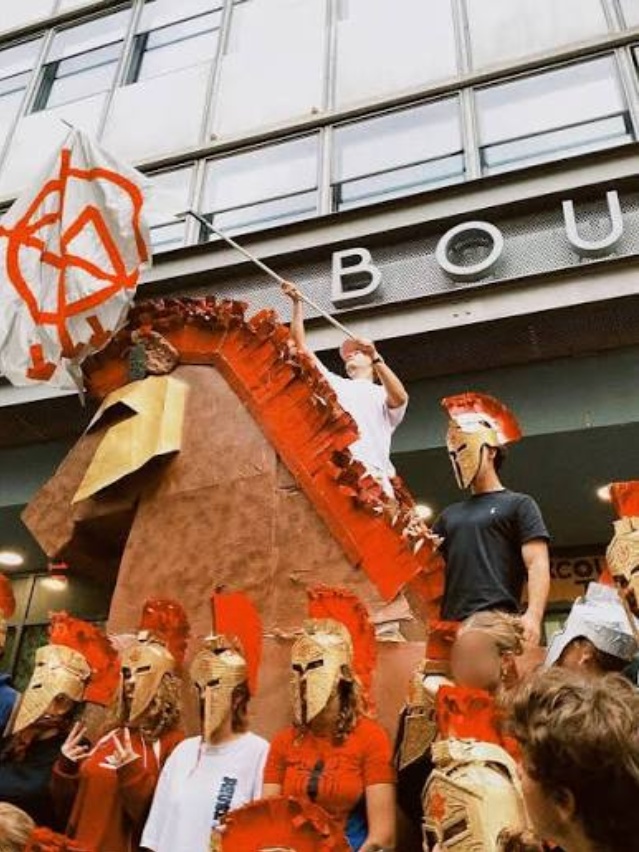

Contemporary times and some ways to end them
Eds. note: The influencer Rayan PSN called on Twitch for people to join him on October 17 announcing “the end of the contemporary epoch.”
October 17th: the end of contemporary times. “And what exactly are you going to replace them with?” will ask microphones and those inevitable repellents of revolutions. We’d rather take a moment to specify what we’re done with.
Contemporary times opened on a series of revolutions forcing governments to find new methods of counter insurrection. Adding to repression came appropriation. Power was reformed and strengthened by its own rejection. Stepping out of contemporary times means enacting a revolution without strengthening what it fights.
In contemporary times, even words of contestation are tools for state powers. Democracy, people, emancipation, nation, class, interest, legitimacy, power and so on : all the concepts available prevent an actual disruption with the dominating paradigm. It’s about time insurgents arm themselves with their own language.
Contemporary times ripped off our weapons and gave them to assemblies and constitutions. For about 200 years, the most has been done to isolate our “voices” in the privacy of voting booths. We won’t ever yield our potency again.
Contemporary times dictated for us what we are. Imposed identities of nation, gender, class prevented us to exist in another “We”. “Society”, with all the submission it intakes, was forced upon us, commanding the destruction of all that resists. We intentionally refuse to collaborate with society.
In contemporary times, under the guise of progress, the myth of a production improving living conditions was believed by all. Marxism prevents us from understanding that nothing can be done with the means of production and therefore it has to be buried.
Insurrections in this era are about decline. Nobody believes growth (even green, social or reasonable) will bring back “decent” living conditions. We need to oppose a new culture of resourcefulness and joint efforts to the production paradigm – a cover-up for confinement and generalised labour.
Contemporary times were not just another civilised step. They unified all logic of production and institution they could grasp. Patriarchy, feudalism, slavery, colonialism, racism and waged work were used in the service of a global functioning economy. Stepping out of contemporary times isn’t opening a new era of civilisation, but starting a revolution that destroys civilisation.
Revolution is a leap into the darkness.

Overcoming the Fear of Fire
Text written by Terrain Vague, on the eve of 24 October
Even though the so-called “high school student” movement largely eludes attempts at control—remaining disparate and autonomous—the same impulses toward “clarification” can resurface: defining what the movement actually is—whether it’s a student movement, a riot, or a revolution—seeking to structure it, formulating clear demands, or outlining a political agenda. It is as if one must, at all costs, impose a direction upon something that is overflowing, before it slips entirely from our grasp. This desire to name, to make demands, to frame what is rising up, and to assign it a specific meaning or outcome, may stem from fear: a legitimate fear of repression, but also a fear of things spiralling beyond control.
Faced with repression that is as severe as it is spectacular, there arises a fear that the potential losses outweigh the gains. The horizon of victory remains hazy, while the repression is tangible, lethal, and already underway. Yet, it is precisely because we do not know what we might gain that the horizon remains open: the risks we take today could become the very conditions for possibilities we would never have dared to imagine on our own.
Beyond the fear of being killed by the police, there is also the fear of not having enough people with us—the fear that others might pull back, leaving us to face the risks alone. Everyone begins to anticipate the withdrawal of others, waiting for someone else to take the first step, seeking guarantees before committing. In the end, we come to believe that we are the only ones who want to keep going—that, ultimately, we are nothing more than a powerless minority. Fear intensifies when we cut ourselves off from a movement and its momentum—when we align ourselves with those who watch it from afar. It is precisely this fear that those in power seek to exploit. They want to convince us that we lack the means to continue, that defeat is inevitable, and that resistance can only lead to further repression. The state of emergency and the rhetoric of security threats are part of this endeavour: to frame “order” as an absolute necessity, “insurrection” as a danger, and “submission” as a safe haven. The goal is no longer merely to repress those who take action, but to deter those who might otherwise join us.

Furthermore, the impulse to clarify and organise our struggles often stems from a fear of things spiralling out of control—a fear of the unknown, of what might carry us further than we had anticipated. While understandable, this reflex paves the way for authoritarianism and brings movements to an end by stifling their spontaneity, their joyful madness, and their inherent unpredictability. It is a fear of possibilities that we can neither foresee nor master—as if we could only act on familiar ground, provided we could calculate the risks and guarantee the outcome. Yet, it is precisely within uncertainty that new possibilities are invented, and that unexpected forms of solidarity and strength are discovered.
Acting without knowing where it will lead does not mean abandoning all vision; rather, it means refusing to have the limits of the possible defined in advance. This is where freedom truly resides: in the capacity to reject everything that dominates us, to open up possibilities with no guaranteed outcome, and to collectively invent what does not yet exist.
THOSE IN POWER ARE AFRAID, TOO
Afraid of losing control, of seeing dissent spread, and of no longer being able to isolate those who rise up. This show of force is intended to stun us and to restore credibility to an authority that has grown fragile.
The helicopter circling over Paris while the streets are already illuminated at night highlights a contradiction: the authorities deploy their force to intimidate, yet this very display reveals how desperate they are to make their control visible. While state violence remains a tangible reality that wounds and kills, the fear of repression should not cause us to lose sight of the “enemy”—nor should we mistake the state’s power for an inevitable, unchangeable fate. No regime can take the obedience of the population for granted. Recent uprisings by Gen Z have also shown that the obedience of security forces is not guaranteed: police officers or soldiers may hesitate, hold back, or refuse to follow orders. Power dynamics are not immutable.

Overcoming our fears does not mean denying them, nor does it mean blindly rushing into confrontation.
While the existing power structure must indeed be overturned through conflict, there is no single way to participate in this struggle—nor is there a hierarchy of courage with direct confrontation at the pinnacle. Anti-repression work, supporting those facing legal action, providing first aid, disseminating information, engaging in discussion, occupying universities, or even organizing childcare during demonstrations—all of these are ways to contribute to the struggle. They weave bonds of solidarity and allow the movement to endure. Not everyone has to do the same thing; each person should be able to find their own role, without fear, guilt, or group pressure dictating their actions.
Fear is not overcome by pretending there is nothing to fear or that one is in total control; rather, it is about ensuring that fear does not dictate our decisions. It means accepting that we do not know how far we will go, what we will gain, or what might emerge from what is falling apart. It means not seeking to guarantee the outcome of our revolt in advance—so as not to reduce the unknown to the limits of what we already consider possible.
Refusing to give in to fear also means refusing to dissociate ourselves from those whom the powers-that-be label as “rioters” or “troublemakers”—a tactic used to isolate and delegitimize the revolt. It means refusing to distance ourselves at all costs from those who step outside the “acceptable” bounds; it means rejecting the dividing lines drawn by the authorities themselves, and refusing to contribute to the isolation of those who are confronting repression head-on.
It is precisely through collective action—diverse and inherently full of internal conflict—that fear (even if it does not vanish entirely) becomes shared, diluted, and stripped of some of its power. We discover that others are trembling too; that one can hesitate without giving up, participate without risking everything at every single moment, and move forward without the certainty of victory. Collective strength does not eliminate danger; it simply ensures that we no longer have to face it alone. Perhaps this is where revolution begins: in the refusal to wait for reassurance before taking action, and in the discovery that the order of the old world—often presented as insurmountable—is, in fact, riddled with cracks.
1. Authors’ translation 2. Machine translation
Subscribe to Freedom anarchist journal, sustain radical publishing and support independent media.


£1.00


£20.00


£0.01


£18.99

£16.99
Freedom
Bookshop
Angel Alley 84b Whitechapel High St London E1 7QX
Opening hours: 12pm to 6pm (Mon-Sat), 12pm to 4pm (Sun)



£9.00


£2.50


£15.00


£5.00


£8.00


£5.00


£10.00


£5.00

£7.50


£5.00


Browse 140 years of anarchist commentary and reporting from the Freedom digital archive
EXPLORE THE
Archives
Latest

Struggle of the Invisibles
As Brazil faces the false choice between Lula and Bolsonaro, squatters from Belo Horizonte resist the expropriation of homes

Paying to be lied to
Notes from the US: A third of the adult population is still taken in by MAGA, which is busy rigging the midterms and accelerating climate collapse


£14.99

£14.99

£12.99


£25.00

£14.99


£15.00

£19.00


£4.00

£4.50

Source: freedomnews