
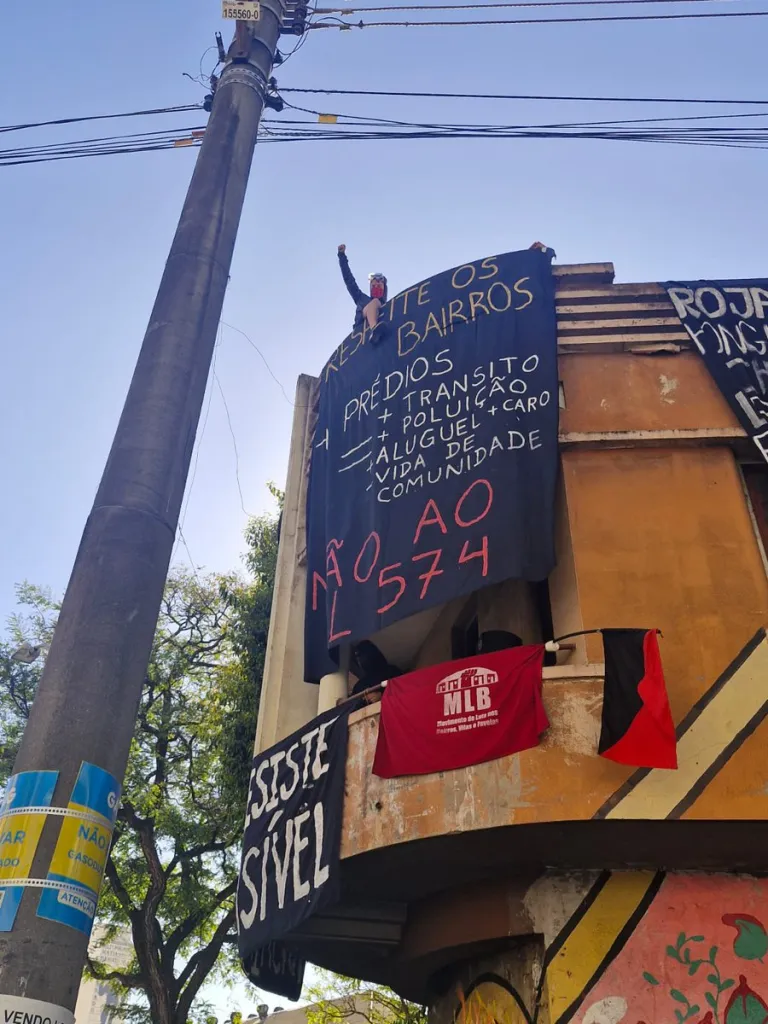

History repeating itself might be a bad joke, but the tyrants of our nations and empires seem to be the ones most intoxicated by this myth. We are repeatedly threatened by democratic fascism at the ballot box, and sold the lie of the gentle military coup when it fails, while corporate bulldozers take our homes from under our feet.
Confronting this nationalist paradox is a radical politics on the streets of cities like Belo Horizonte, resisting the global wave of displacement which sees homes expropriated for the insatiable greed of the markets. Local direct action and international solidarity is how the landless stand their ground against the corruption of speculation.
“We are on the edge of the centre,” a resident of the Kasa Invisível occupation says. “but still in the centre, right? We are in the centre of the city, where all the money of the city is, but we are not the owners of that money.”
The world focuses on Brazil ahead of the elections, when 160 million people will be eligible to stake their political future on the false duality of national democracy. One a clone of the status quo, the other a clone of the military dictatorship. “Lula or Flavío Bolsonaro?” a man is asked on the streets during an interview on social media.
“Neither,” he replies. “I’d rather take a bullet to the head.”
“In an imposed regime of visibility, many things are ‘unseen’ and thus remain invisible,” writes Thiago Cannettieri on the (in)visibilities of the city. “but it is in this very moment, like a counter-strike, that allows one to escape from the dominant regime of visibility.”
‘Grandpa left’
It was early in the morning when a removal van arrived on Av. Bias Forte. On the orders of Judge Miriam Vas Chagas at the civil court of Belo Horizonte, an entourage of the heirs of the estate of José Alves had arrived at the Kasa Invisível occupation, flanked by an attorney, locksmith, bailiff and two workers.
The family of a dead man had come to ‘repossess’ his property after decades of abandonment and disrepair. The occupation of Kasa Invisível started in 2013 as the “spirit of rebellion, radicality, autonomy, direct action and the search for self-management and liberation of territories,” led by a group of occupants that over the next decade cleaned, maintained and repaired the three buildings first built in 1938.
Despite this, the reason stated for the repossession of Kasa Invisível was property damage. The occupation is located on an intersection that forms a star shaped junction that included five main occupations of historical buildings during the Covid-19 pandemic.
These modern revolts against property are build on the land of disputes going back to the early 20th century. The villages and wildlife destroyed by political elites that dreamed of cities that would be resistant to rebellion and barricading. The former Palácio de Liberdade is said to be cursed by Maria Papuda, a poor black peasant evicted from the land without compensation in 1894.
The Kasa Invisível is located at the cross section between the halls of government and a viaduct that serves as a shelter for the homeless. Centrally located, buildings and lots have been left abandoned for decades and so become the homes of the landless. It is an area that is now the target of a bill being passed through the Belo Horizonte Council known as PL 574/2025.
The bill was first proposed by Mayor Álvaro Damiáo who happens to be the final signature in the legislative process. In between this process, the bill was sent to the City Council for approval, including to Councilor Bráulio Lara. After speaking to his constituents who happened to be a lobby group of sixty real-estate developers led by Sinduscon-MG, Lara became convinced of his democratic commitments.
Outside of Kasa Invisível, a crowd of housing activists, squatters, lawyers, human rights commission and parliamentarians had blocked the entrance from the outside and barricaded from the inside as the bailiff and locksmith were prevented from entering. A local rapper spoke to the two workers operating the removal van and convinced them not to support the eviction.
The attorney of the heirs of José Alves resorted to filming the protesters on a phone as they shouted back to the retreating entourage: “Grandpa left, you forgot and now you lost.”
‘You forgot’
At the end of the military dictatorship in 1985, the Landless Workers Movement (MST) demanded the guarantee of basic rights for housing, food and protection of communities. They made a bold rejection of the accumulation of land for speculation as “a disrespect to the law” – demanding the seizing of rights through direct action and occupation of land.
In Belo Horizonte, 56,000 families were living without a home in 2019, with a further 95,700 individuals living without water, sewage or a roof. 100,000 people were living in occupations of abandoned buildings and land in the year of the outbreak of Covid-19. Organisations like Workers Movement for Rights (MTD) and Movement for Struggle in Neighbourhood Villages and Favelas (MLB) have supported these occupations and fights against eviction.
“When the hegemonic strategy of the left was to ‘wait for fascism to melt away on its own’, expecting elections would function as the vaccine for the pandemic,” writes Renato Baruq, “anti-fascists took to the streets and excluded individuals with different histories resorted to direct action, squatting houses and fighting for their rights.”
The Aniky Lima occupation was named after the Brazilian transvestite activist who died at the age of 65. The squat was occupied in April 2021 and only half a year later the owners of the building filed for eviction. Localiza, the car rental company, had also given financial support to the election campaign of Jair Bolsonaro. With the support of Kasa Invisível, residents marched to City Hall to demand rights to housing assistance in spite of this corruption.

Casa Tina Martins is considered the first occupation by woman in all of Latin America, squatted in 2016 as a response to discussions in feminist and housing movements “about the inefficiency of public policies to combat violence against women, recognizing the essential role of a structure that enables dignified life.” The police were (are) doing next to nothing to combat violence against women.
Despite negotiations and the guarantee of a place for supporting women affected by violence, Casa Tina Martins is still at risk of eviction. Activists provide legal, psychological and social assistance as well as shelter, a support network that cannot be replaced by a bill that allows the building of taller buildings in the centre of the city. It is solidarity that they seek to demolish.
‘Now you lost’
“It should be free to sell,” Mayor Damiáo tells a local newspaper about Concórdia, an area that said no to his bill. Despite initial claims of protection, he goes on to state “the government cannot force it to keep the land. The decision should belong to the owner.” Under the lie of ‘urban renewal’ the community is sold from under our feet. They force us back into the realms of the isolated and silenced.
“The project conceived at Kasa Invisível has this as it’s raison d’etre,” writes Cannettieri: “Possibility of using invisibility to establish another regime of visibility.”
As the displacement of Belo Horizonte’s radical squatter community start to intensify, the counter-strike is a maximum solidarity of zero evictions. At the end of September, forty organisations from across Brazil, Latin America and across the world signed a manifesto that would be sent to the UN Special Rapporteur on Housing. It is a declaration against the tyranny of the global property markets.
“The experience of Belo Horizonte shows us that the so-called ‘housing crisis’, which currently affects major cities around the world, and effects of real-estate speculation on the lack of affordable housing are not inevitable phenomena,” the manifesto states.
“It also shows us the importance of collective organisation and solidarity in reclaiming the city as a common good.” From Catalunya to Euskal Herria, Italy to Argentina, and Birmingham to Kyiv, housing associations and activists are resisting the expropriation of our community, the land and the common good for profit.
Or as Cannettieri writes: “Invisibles of the world, unite (and put an end to it!)”.
Subscribe to Freedom anarchist journal, sustain radical publishing and support independent media.


£19.99

£21.99

£19.99

£12.00


£25.00

£12.99

£18.00


£10.50


£22.99

Freedom
Bookshop
Angel Alley 84b Whitechapel High St London E1 7QX
Opening hours: 12pm to 6pm (Mon-Sat), 12pm to 4pm (Sun)


£0.01


£9.00


£2.50


£15.00


£5.00


£8.00


£5.00


£10.00


£5.00

£7.50


£5.00


Browse 140 years of anarchist commentary and reporting from the Freedom digital archive
EXPLORE THE
Archives
Latest

Greece: Teachers and students strike against the cost of living
Thousands marched in Athens and other Greek cities to demand increased funding for education, better wages, and solutions to the housing crisis

Barney Greenway: “Moments that hit home are few and far between”
Interview: Napalm Death vocalist talks about his political development, dynamics with bands and fans, and having dialogue with people we disagree with


£14.99

£14.99

£12.99


£25.00

£14.99


£15.00

£19.00


£4.00

£4.50

Source: freedomnews