
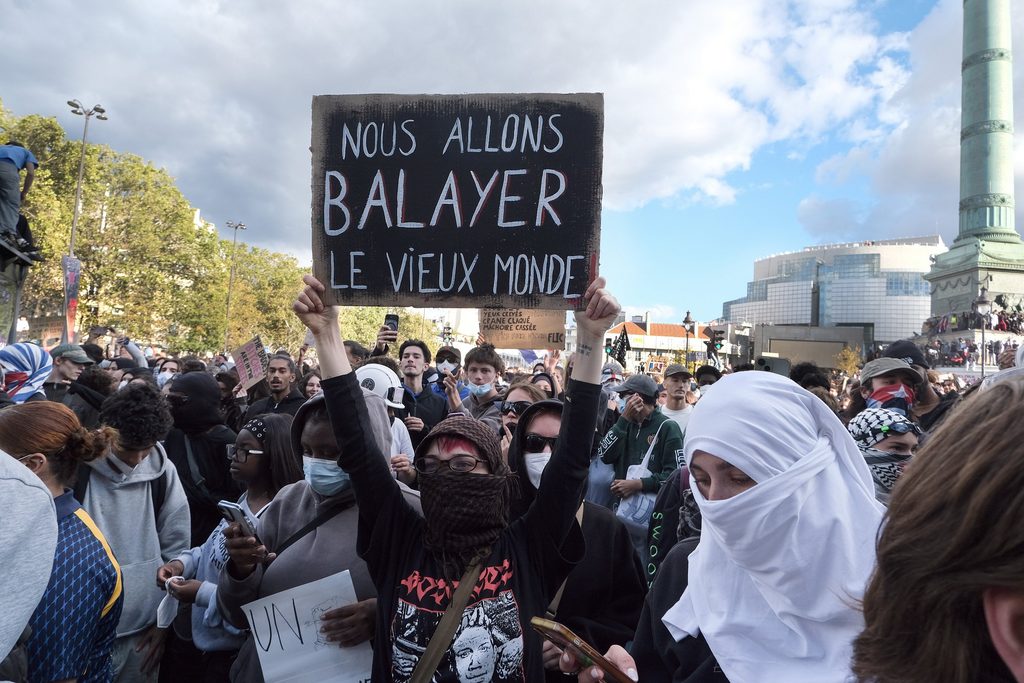

by Alessandro Stella
from lundimatin #537, 12/10/2026
The student movement, which has spread like wildfire across France in the fall of 2026, was entirely the work of the secondary school students themselves. Without anyone behind them, without a party, without a union pulling the strings, they acted entirely on their own, like adults. They forced all the adults, all the authorities responsible for them, to take them into account.
The Rebirth of a Revolutionary Youth
They did so by denouncing the undignified and discriminatory conditions of their schools, by expressing their material and psychological suffering, and by formulating concrete and relevant demands. They did this by talking and discussing amongst themselves, by organising within the school, by creating a clear message on banners and placards, and then by taking action.
The form of action chosen by these rebellious secondary school students was to block the entrances to their school. They erected barricades of garbage cans, wooden pallets, street furniture—anything they could get their hands on. It was essentially a picket line and a mobilisation effort, forcing people to look at what was written on their placards and to discuss it. This form of action was adopted throughout France within a few days and quickly became a major news story. With very limited resources, through word of mouth, from group to group, via affinity networks, and then through social media, it spread; modern-day self-organisation, and it worked.
Faced with this youth revolt, the possibility of which had escaped everyone, including Laurent Nuñez (minister/prefect/head of the intelligence services), the State immediately decided, “as an adult responsible for protecting its children,” not to listen to the voices of the protesting secondary school students, but to bring them back into line and discipline. “We asked to be able to take the Baccalaureate exam, and they sent the riot police after us,” the students responded. With unimaginable brutality, especially towards teenagers, causing lifelong disabilities, injuries, and trauma: beaten, handcuffed, violently thrown into a police van, then into a squalid police station cell. In police custody, at 15 …
The rebellious youth managed to resist, to refuse to submit, and instead to fight back physically and morally, every single day. Day after day, without giving up, driven by an awareness of the injustices they suffered, rage against those who controlled their destinies, and a desire for a better future. “Fuck no future!” These ideas resonated with young teenagers everywhere, in cities and in the countryside, fuelling the collective movement. They spread rapidly because these ideas found fertile ground. With few resources, no big guns, no money, no central, structured organisation. Without leaders, just facilitators, collective experiences, self-organisation, and coordination.
The secondary school student revolt in the fall of 2026, despite the price paid in the flesh, has already achieved several victories. In the immediate aftermath, without even realising it, they had disrupted all political and electoral agendas and forced all the powers that be to look at them, to listen to them, especially when they shouted to finally be heard.
The visual, spatial, and sonic emergence of this secondary school student revolt clearly reveals that the spearhead of the rebels are young people from the French colonial past, living in disadvantaged working-class neighbourhoods on the outskirts of cities, who have endured generations of daily humiliation, contempt, and exclusion. This is undoubtedly a first in the history of student revolts, from 1968 to the present day.
The other defining characteristic of this secondary school student movement is this cry of revolt, this rejection of “infantilism,” namely, the denigration of a person based on their age. This discrimination should be considered among the structural forms of inferiority and oppression in our societies, alongside classism, machismo, racism, and all forms of supremacy, based on the contempt of those who look down on another person.
These young people are rebelling against all the schizophrenic powers that dominate them; Legal minors, subject to parental authority, without the right to vote, yet old enough to be beaten, injured, detained, or even imprisoned.
Through their struggle, they have shown and demonstrated that they have ample reason to revolt, that they are capable of taking charge of their own lives and self-organising, as autonomous as adults, without needing anyone to look after them.
Behind the scenes?
To deny that 14- to 17-year-olds could take matters into their own hands and trigger such a social and political upheaval, the State and its government immediately accused “LFI and its far-left proxies” of being behind the rebellious secondary school students. This is a blatant falsehood, a malicious attempt to discredit both the student movement and LFI and its allies. Undoubtedly, the rebellious secondary school students draw their inspiration from past struggles and experiences, both old and new, appropriating and renewing them. But no social movement is ever a carbon copy of a previous experience.
Of course, activists in organised groups dedicate themselves in their workplaces or schools to sparking debates, anti-establishment critiques, and initiatives for resistance. But most often these initiatives remain limited; the influence doesn’t spread, because the influences circulating are numerous. Until the day when, suddenly, rebel groups form, multiply, and coordinate to seize the political space.
At the forefront?
The image of Louis Boyard, LFI deputy, with his tricolour sash, sitting in front of hundreds of students staging a sit-in on Rue d’Assas, is a disaster. For him and the party he represents, but above all, for the nascent student movement. It’s clever. If the goal was to reinforce the Machiavellian insinuation put forward by the government and provide visual proof that LFI was perhaps not behind the revolt but rather at the forefront, it succeeded. Except that the reality is different. It was indeed the students from the universities in the Latin Quarter who had organised the blockades and street demonstrations, and Louis Boyard, with his youthful appearance, could easily have blended in with the others, without any distinguishing characteristics. But the LFI deputy wanted to strike a pose reminiscent of Daniel Cohn-Bendit facing a police officer, implying that the police should step over him to attack the young protesters he had come to protect. In this sequence, everyone clearly saw the LFI’s attempt to co-opt the protest movement for its own partisan and electoral ends.
In constructing the web designed to capture and domesticate its prey, the State has long used the weapon of manufacturing leaders of the struggle, aided by complicit media outlets. Most often, they select representatives from student unions, who are not necessarily the driving force behind the struggle, far from it, and propel them onto the stage through the media machine. Invested with the title of leaders, they will have the legitimacy to speak on television and radio on behalf of all the protesters, and will then be the only ones authorised to represent the movement in negotiations at the Ministry. Now, to pass the audition and have a chance of being promoted to leader, one must obviously fit the required profile: be rebellious yet reasonable, angry yet measured, uncompromising yet open to negotiation. They must also, in all seriousness, present a list of precise and budgeted demands.
And that’s all there is to it. Since May of ’68, we have seen several generations of former “student leaders” who quickly became members of parliament, senators, deputy mayors of Paris, and so on. Have they turned their backs on their social origins? In any case, they haven’t really strayed from them. It is as if the UNEF [National Union of French Students], secondary school student unions, and associations like SOS Racisme, Ni Putes Ni Soumises [Neither Whores Nor Submissives], and others serve only as springboards for ambitious young people to find cushy jobs in institutions run by social democrats; profiteers and traitors to worthy causes.
The search for, construction of, and promotion of leaders is an integral part of the state’s battle to destroy social movements of revolt, which are inherently based on collective rather than personalised functioning. And it must be said that the groups and parties claiming to be revolutionary also reproduce the creation and promotion of leaders, of figures named Jean-Luc Mélenchon or Anasse Kazib. The personalisation of the struggle is seriously detrimental to the struggle itself.
With whom?
The image of Bally Bagayoko, mayor of Saint-Denis, who openly supported the secondary school students in his district from the very beginning, had a different meaning. It represented the support of the closest institution, adding legitimacy to the struggle of the suburban vocational high school students, discriminated against and racialised, proud to revolt. And their mayor was there to support them, like other mayors of working-class districts.
Following the surge of police violence, labor unions, parent-teacher associations, and human rights organisations called for the defense of the secondary school students, “our children,” from police violence and from the violence of the “rioters.” Of course, as if to be promoted to leader of the movement, the labor unions must accept the police information that “the rioters are outsiders to the secondary schools, only wanting to sow disorder and clash with the police.” Given the profile of the thousands of young people arrested—nine out of ten minors and secondary school students—union leaders should revise their analysis and stance.
All participants in a revolutionary social movement, inevitably subject to repression, need solidarity and support from associations, unions, and parties that understand and share their cause. Just as the homeless need blankets, the sick need medical care, and the accused need lawyers. Their institutional position provides a role of protection and defense. And that’s all to the good.
Inside?
To be inside, to truly participate from within, one must be on the same level, at the same footing as everyone else, without distinction. The Yellow Vests understood and promoted this well: in a yellow vest, everyone is the same, on an equal footing, regardless of profession, age, or clothing. Whether in a yellow vest, a black raincoat, or other anonymising clothing, the fundamental principle is that the struggle is collective, that everyone is equal, without any distinction or hierarchy. Everyone participates in the movement according to their abilities and circumstances. No leaders, no one aspiring to leadership, just horizontal, local, and widespread self-organisation.
Without going back to the dawn of revolutionary movements, and focusing on the social movements that have shaken France in recent years, one can only hope that the protest movements of secondary school students, university students, workers, and those in precarious employment of all kinds and professions will manage to escape the grasp of the groups, unions, and political parties that would seek to control and direct them.
Indeed, “left-wing” parties and union confederations have played a decisive role in suppressing the popular uprisings of recent years. By denying its importance and legitimacy in relation to the Yellow Vest movement, and by exploiting the competition between demonstrations, the unions, as is their tradition, refused to join the Saturday protests, the weekly day of the Yellow Vests’ demonstrations.
The power of the national union confederations to impose their agenda of struggles has been a major obstacle to large-scale and determined social movements, such as the fight against Macron’s pension reform. By calling for intermittent strike days, staggered demonstrations, and manipulating the timing of negotiations and other subterfuges, the unions have managed to exhaust and ultimately bring down these widely supported social movements. All of these mass protest movements were simply beyond the control of the unions. They went far beyond the ordinary, comfortable demands that allow the Union, its leaders, and staff to play the role of facilitators of negotiations and compromises—in short, to preserve their organisation’s funding and keep their jobs as union members.
If high school students, like the university students and workers who are rebelling, are well aware that to wage a struggle successfully, one must organise and provide the means to pursue it, why would a centralised organisation be necessary? Why should those rebelling against the capitalist system build a pyramid, reproducing the hierarchical structure they reject, instead of multiplying horizontal links, interconnections, and the coordination of self-organised groups?
Furthermore, why would it be necessary to channel and have converge all the sectoral movements in struggle toward a single program that would summarise all conflicts and hopes? Or toward national demonstrations on fixed dates, instead of allowing free rein to the territorial dissemination of struggles in all possible, imaginable, and surprising forms?
From the movement against the labour law in 2016, to the Yellow Vests, by way of the Soulèvements de la terre [Earth Uprisings] and the student revolt, all of these experiences demonstrate that it is the proliferation of zones or areas of action, rooted in familiar territories and based on local solidarity and complicity, which shakes the powers that be.
The rebellious secondary school students loudly proclaimed that they wanted to be actors, subjects, not objects of their own destiny. That they no longer wanted to be subject to the decisions of the Ministry of National Education, nor the Ministry of the Interior, and even less so to an “algorithm.” Why should they fall in line and submit to political parties, even if they call themselves “Rebellious,” or to unions that arrogate to themselves the authority to represent them and bring their demands before the government?
Let us hope that this new generation of revolutionaries, who have freed themselves from the constraints of structural authority, wanting to be subjects and not objects of their own destiny, does not succumb to the allure of a protective home—another cage—in which one must behave properly and obey the leader.
Alessandro Stella
Illustration: Bernard Chevalier
Ludivine Bantigny, a historian specialising in youth, the Paris Commune, and revolutions, addresses the strange resurgence of references to May ’68 within the secondary school student movement of September-October 2026. For the historian, the upcoming Tuesday, October 13th, could become the equivalent of May 13, 1968, when parents took to the streets alongside their children, and unions and workers swelled in numbers, mirroring the student movement. From Tuesday, October 13, 2026, to May 13, 1968, will the outcome be positive?
Sébastien Charbonnier analyses the ongoing secondary school student movement and the fierce repression it faces through the lens of the power dynamic between the two age groups. The child, etymologically, is infans, the voiceless one, and today the aim is to silence them, even if it means brutalising them. This violence against their bodies consists of correcting what they have not fully grasped; the State then re-explains it to them. The goal is to maintain the adult charade at all costs, at the risk of exposing it and allowing the children’s revolt to spread.
Source: Autonomies