

from The Transmetropolitan Review, 04/10/2026
Click here for the full pamphlet version of ‘The Woman’
Lucia Mancini was likely born in or around Potenza, Italy in 1884. She immigrated to the US with her brother Eustacchio in 1900, eventually settling in Lynn, Massachusetts where she began to read and support the Cronaca Sovversiva anarchist newspaper in 1905.
Lucia and her brother were members of the local anarchist Social Educational Club, which put on events and fundraisers, although Lucia left Lynn in 1907 to pursue work in Connecticut, likely as a seamstress. She rejoined her brother in Wakefield, Massachusetts in 1910 and it was here that she wrote her article ‘The Woman’ for the Cronaca of July 1, 1911.
This text sheds light not only on the condition of women in the early 1900s, it likely explains why Lucia and her brother fled Italy without any other family members.
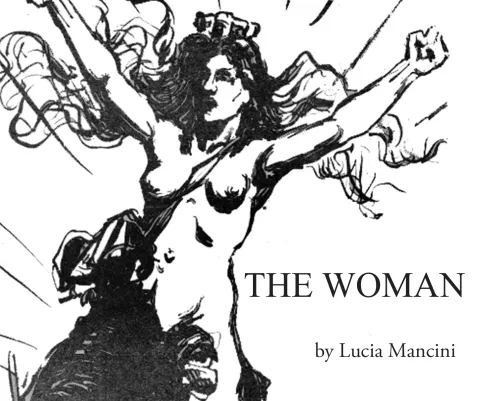
The Woman
When a mother, having endured the suffering and dangers of childbirth, brings into the world a female child, the members of the family consider themselves struck by a misfortune. And in this state of mind, one doesn’t even attempt to work. At times, the brutal husband goes so far as to openly express his displeasure at having become the father of a girl, and dares to upbraid the poor mother, even while she’s still suffering, quasi reproaching her for having failed to conceive a male.
Thus, the woman is regarded as an inferior being, a useless and harmful encumbrance, and represents the family’s greatest source of anxiety, for they contemplate with terror all the troubles that might befall them on account of this being who had the misfortune of being born female.
Because, as is well known, the so-called “honor,” the prestige in other words, the reputation of the family, in accordance with the prevailing morality established upon the canons of the Church and sanctioned by the legal codes, is deemed to rest primarily upon the conduct of the woman.
A family is irreparably “dishonored” when a woman belonging to it, by breaking the bonds of bigoted morality and rebelling against the tyranny of the family itself, acts by heeding the impulses of her heart and the promptings of her own intellect.
The education of women is therefore carried out under disastrous conditions. Her education, generally speaking, is limited just enough to enable her to read the hymnal, although without understanding much of it; absolute ignorance is the guarantee of her chastity.
And when the little girl becomes a young maiden, and her conscience is stirred by the first surprises of puberty, her mother will labor to explain the physiological reality to her with some tangled jumble of words from which she will learn nothing other than that “she has become a woman, and therefore is under an obligation to work harder and be more useful to the family.”
Later, the priest, to whom her bigoted mother entrusts the young girl for the completion of her education, takes care within the secrecy of the confessional to initiate her into the secrets of nature through a series of lewd questions pertaining specifically to sexual life and relations with men. And it is the beginning of the moral perversion that is destined to cloud the purity of conscience, the innocence of the young girl. While she learns from the priest that the male is an insidious creature, one to be shunned until the time of marriage, she will likewise discover that in fact there is a way to satisfy “certain natural needs” without the dangerous intervention of a male, and that one can enjoy oneself even more, and much better.
And from the tyranny of the family which measured her steps, counted and regulated the beatings of her heart, scrutinized and analyzed her thoughts, the young girl will seek to free herself through marriage.
But her husband imposes upon her a far heavier yoke, a fiercer tyranny from which she will be unable to escape save through death, unless she possesses the strength to rebel.
To rebel then, even outside the marital sphere, even within the family, against everything and everyone, is the path to follow in order to achieve emancipation.
When a woman has fully grasped her mission in life, when she knows how to liberate her mind from inherited prejudices and the unfortunate consequences of her upbringing; when she has convinced herself that she is not, as social injustice would have it, inferior to men, only then will the woman know she can be called emancipated. But to improve her conditions, to be able to take her seat at the banquet of life with the same rights as man, she must beg for nothing, rather she must conquer, and to conquer requires strength.
Let woman then become strong, above all intellectually and…she will triumph.
Lucia Mancini
Lucia Mancini wrote this article for the Proletarian Collaboration column of the Cronaca, a column which only featured women writers such as Ersilia Cavedagni and Elena Purgatorio. However, this would be the only article that Lucia ever wrote for the paper.
Lucia would go on to act in and likely direct numerous anarchist plays as part of various filodrammatici, or amateur theater groups. Most of these events raised funds for the anarchist movement, just as they raised the consciousness of those who attended, spreading a coherent insurgent message from one stage to the next.
More information on her life can be found in the forthcoming Lucia Mancini; or, the Anarchist Guerrilla War.
Source: Autonomies