
jeudi 15 octobre 2026, par Courant Alternatif
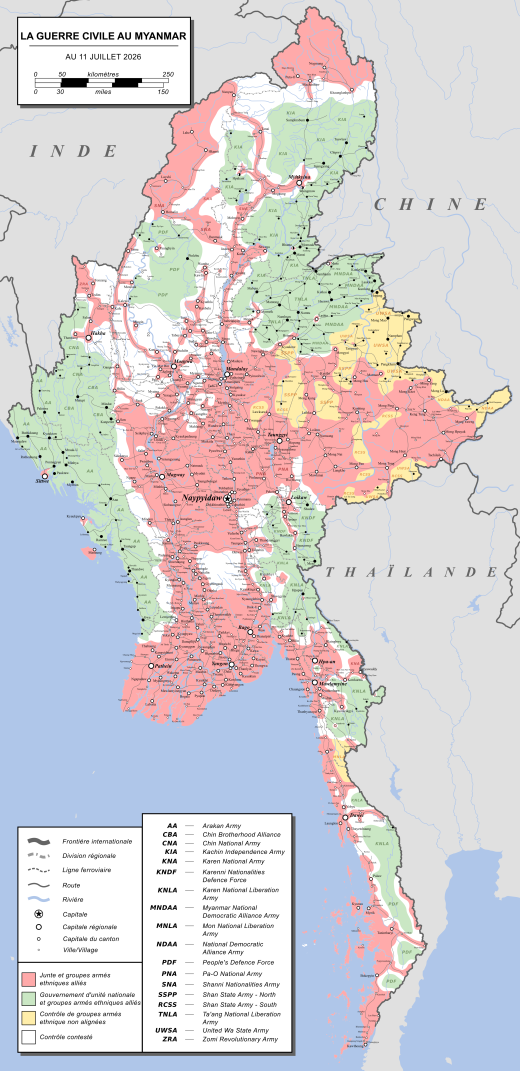
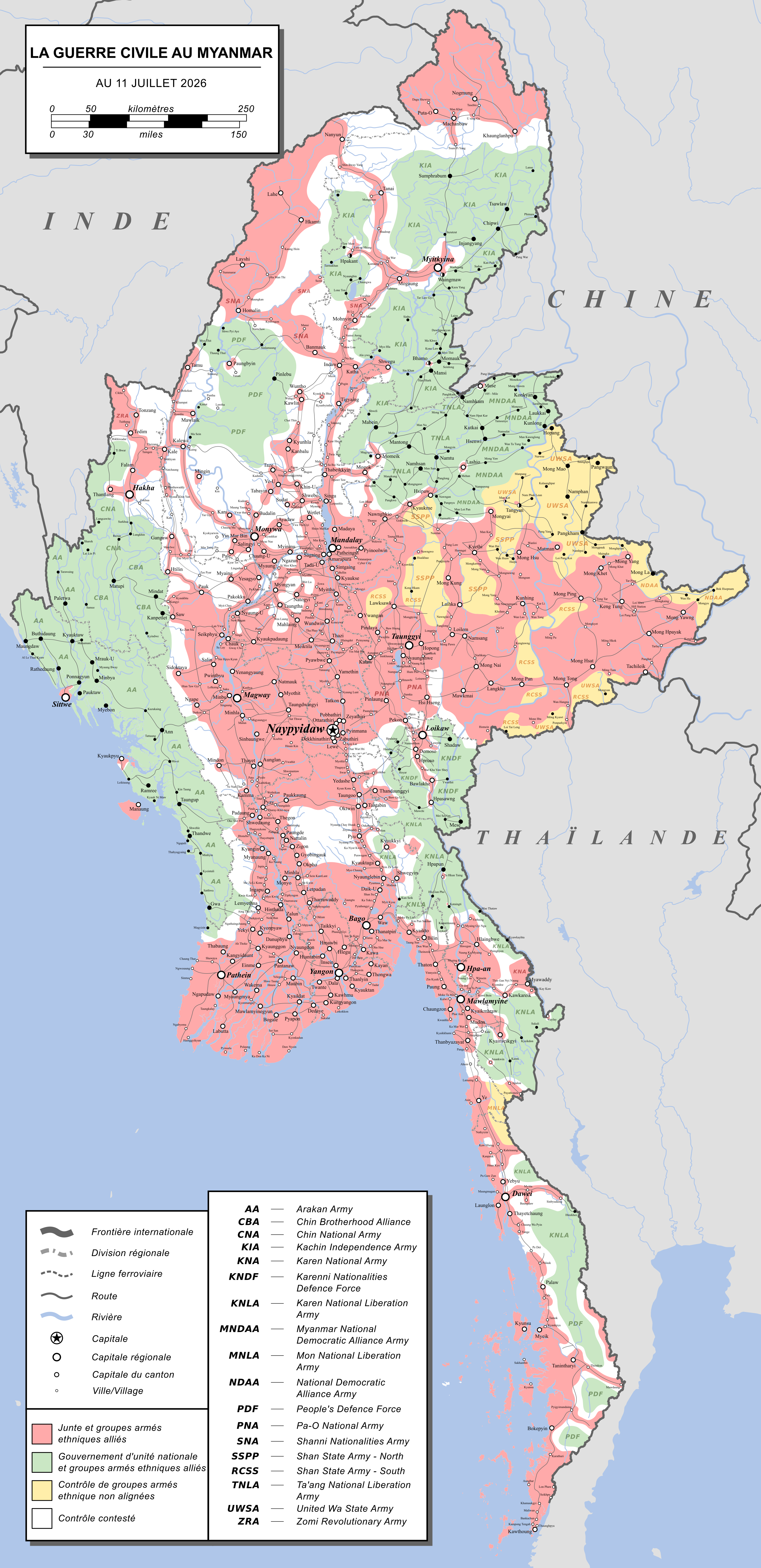
Pour comprendre la situation actuelle en Birmanie, il est nécessaire de revenir à la fois sur l’héritage de la dictature militaire, l’histoire des luttes sociales et ethniques locales, comme sur les diverses tentatives avortées de démocratisation. Après une période de domination par le Japon pendant la seconde guerre mondiale, et devenu indépendant du Royaume-Uni en 1948, le Myanmar, dont le territoire accidenté n’a jamais été réellement contrôlé par les britanniques, voit s’affronter le gouvernement central à des mouvements ethniques armés (Karen, Kachin, Shan, etc.) et à la guérilla du Parti communiste birman (CPB). L’armée, héritière des forces coloniales, se présente comme le garant d’unité nationale fantasmée, tant le pays est une mosaïque ethnique et culturelle. En 1962, le général Ne Win prend le pouvoir par un coup d’État et instaure un régime militaire. L’armée, rebaptisée Tatmadaw, devient l’institution centrale du pays, contrôlant l’économie et l’administration pendant que la répression s’abat sur l’opposition. Le Myanmar restera isolé sur la scène internationale pendant des décennies, sous sanctions économiques, pendant que ses habitants s’enfoncent dans la misère. Ils le resteront, car encore aujourd’hui un quart de la population vit sous le seuil de pauvreté. En août 1988, une révolte massive éclate, connue sous le nom de « Soulèvement 8888 » : des millions d’étudiants, ouvriers et moines bouddhistes descendent dans la rue pour réclamer la démocratisation du régime. La répression est sanglante. Face au régime, une partie de l’opposition birmane prend les armes ou intensifie sa lutte préexistante. Citons L’Armée karen de libération nationale, le Parti communiste de Birmanie (CPB), et Le Front démocratique des étudiants de Birmanie, fondé en 1988 par des militants étudiants, qui devient l’un des principaux groupes de résistance. En 1990, la junte organise des élections et la Ligue nationale pour la démocratie (LND) d’Aung San Suu Kyi les remporte. La junte annule le résultat, maintient son pouvoir, et place Aung San Suu Kyi en résidence surveillée pendant 15 ans. Cet échec renforcera la résistance armée comme seule alternative. En 2008, le régime militaire lance une réforme politique et adopte une nouvelle Constitution, qui maintient le rôle dominant de l’armée (elle contrôle 25 % des sièges au Parlement et conserve les ministères clés comme la Défense et l’Intérieur). Malgré une nouvelle victoire en 2015, la LND n’a donc qu’un pouvoir limité. Souvent présenté par les blocs centraux occidentaux comme une période de « transition démocratique » (en réalité plus une stratégie de l’armée de libéralisation économique), ses résultats s’avèrent plus que mitigés : – Les conflits ethniques persistent (guerres contre les Karen, les Kachin, les Rohingyas) ; – L’exploitation capitaliste se renforce : droits des travailleurs bafoués, syndicats désormais autorisés mais réprimés par la LND, salaires extrêmement bas malgré la création, rapidement délaissée, d’un salaire minimum, investissements étrangers captés par les élites militaire, qui contrôlent, et disputent aux minorités ethniques depuis des décennies l’extraction du gaz, des pierres précieuses et des ressources naturelles ; – L’armée mène à partir de 2017 une campagne de nettoyage ethnique contre la minorité musulmane des Rohingyas, provoquant l’exode de 700 000 personnes vers le Bangladesh, dans le silence d’Aung San Suu Kyi. Cependant, après les élections de novembre 2020, qui ont donné une victoire écrasante à la LND, certains généraux craignent une réforme de la Constitution, ce qui les pousse à fomenter le putsch du 1er février 2021. Ce coup d’État déclenche la « Révolution du printemps », un soulèvement marqué par des manifestations massives et la forte présence d’une jeunesse ayant grandi à l’ère d’internet. Dès les premiers jours, la junte écrase toute contestation : 1 500 morts, 12 000 arrestations, torture, viols et exécutions extrajudiciaires seront recensés. Face à cette violence, une partie de la population se tourne, comme en 1988, vers la résistance armée : – Création des Forces de défense du peuple (PDF), des milices populaires formées par des civils, souvent issues des syndicats et des mouvements étudiants ; – Des groupes ethniques armés s’allient temporairement avec les PDF, et lancent en 2023 « L’opération 1027 » et prennent le contrôle de dizaines de villes. La résistance est aussi ouvrière : les grèves massives de 2021 (ouvrières du textile, des enseignants, des mineurs) réussissent à paralyser l’économie, tandis que la solidarité ouvrière permet aux différents groupes armés de se financer. La junte interdit 16 syndicats et arrête des dirigeants, poussant les militants à la clandestinité ou à l’exil. La lutte amorcée par les travailleurs pendant la décennie de libéralisation se poursuit actuellement donc sous d’autres formes. On aurait donc tort de ne donner qu’une lecture identitaire et ethnique du conflit. Le Myanmar est aujourd’hui divisé en trois zones : 1. Les territoires contrôlés par la junte : principalement les grandes villes (Naypyidaw, Mandalay, Rangoun) et les axes routiers ; 2. Les zones tenues par les groupes ethniques armés (Karen, Kachin, Shan, Arakan, etc.) ; 3. Les territoires libérés par la résistance populaire (PDF et alliés), où des gouvernements locaux alternatifs tentent de s’organiser. Pour maintenir son pouvoir, l’armée utilise des méthodes de guerre totale : bombardements aériens sur les zones rebelles, blocus économique (coupure d’Internet, restrictions alimentaires, pillage des ressources), recrutement forcé (la loi de 2024 impose l’enrôlement des jeunes hommes, provoquant un exode massif de réfugiés vers la Thaïlande.
Afin d’y voir plus clair, et de penser la révolution et la solidarité internationale dans le contexte de guerre civile au Myanmar, nous publions une interview d’un camarade de “l’Antifascist internationalist front” (AIF, une organisation politique internationaliste implantée localement), que nous remercions chaleureusement de nous avoir accordée.
CA : Peux-tu te présenter brièvement ? H : Je m’appelle H. et je suis un ancien commissaire politique de l’AIF. Je suis un internationaliste originaire de l’Île de la Tortue (Amérique du Nord) revenu sur place après avoir participé à la révolution au Rojava puis à la Révolution de Printemps au Myanmar. En tant qu’ancien membre de l’AIF, je ne représente pas officiellement l’AIF. Cependant, je peux témoigner de ma propre expérience après avoir travaillé sur le terrain avec nos camarades. Il convient de noter que ma perspective est celle d’un internationaliste qui a été invité à rejoindre la révolution et non celle d’un habitant du Myanmar ayant grandi sur sa terre sacrée et ayant subi l’oppression d’une junte militaire ayant déniée toute vie libre à ses habitants.
APERÇU DE LA SITUATION ET DES FORCES LOCALES EN PRÉSENCE L’ÉTAT, L’ARMÉE, LE CLERGÉ
Le gouvernement central reste-t-il puissant ? Quelle est sa base sociale dans les territoires qu’il occupe ? L’armée a complètement repris le contrôle de l’État depuis le coup d’État de 2021, donc le gouvernement central n’est vraiment à ce stade que le haut commandement du Tatmadaw, désormais appelé la junte. Sur le plan intérieur, la junte s’appuie sur l’ancien pouvoir de la société Bamar (1). D’un point de vue économique, le pouvoir de la junte peut-être vu dans l’oligarchie qui a choisi de rester et d’accepter le fascisme alors que d’un point de vue social le pouvoir de la junte provient presque entièrement de l’ancienne gérontocratie du clergé bouddhiste. C’est une relation d’occupation fasciste classique, qui manipule la société là où c’est possible, en prétendant que la junte serait le seul administrateur possible, et qui utilise la force là où la manipulation s’avère plus difficile. Nous pouvons commencer par le côté économique de cette question. Lors du coup d’État de 2021, les entreprises birmanes ont été forcées à la pointe du fusil à se ranger du côté du Tatmadaw. L’oligarchie s’est alors divisée en trois parties. La majorité a purement et simplement quitté le pays, une partie est restée pour jouir de la protection militaire en échange d’un contrôle militaire direct et d’un isolement presque total du monde extérieur, et enfin une toute petite minorité est restée pour soutenir la résistance. Le Tatmadaw a utilisé cet exode corporatif comme stratégie pour contrôler les travailleurs vulnérables. L’exode de 2021 a entraîné un chômage généralisé parmi les travailleurs qui n’avaient pas les moyens de partir, et la junte s’efforce depuis de les recruter à divers postes militaires via la conscription. Cela signifie aussi que la révolution est prolétarienne par défaut, car elle est composée largement de travailleurs et de familles qui n’avaient pas les moyens de fuir ou qui ont refusé de le faire. Au-delà de l’oligarchie, le pouvoir social notable dans cette équation de légitimité interne du Tatmadaw est le clergé bouddhiste. Depuis longtemps, des pagodes (2) ont été implantées par la force au plus profond des marges autochtones. Bien que certains éléments (principalement les plus jeunes) du clergé bouddhiste aient déserté pour rejoindre la résistance, son élite patriarcale bien enracinée tend à s’aligner avec la junte. Bien que le clergé bouddhiste soit de loin l’acteur religieux le plus important au Myanmar, il n’est pas le seul existant. Certains ont même pu bénéficier de la révolution, comme par exemple le clergé chrétien, qui peut maintenant opérer publiquement dans les zones libérées après avoir été interdit pendant de nombreuses décennies. Bien qu’il existe certaines formations explicitement religieuses dans la révolution, la Révolution de Printemps reste cependant largement séculière et entend affaiblir le monopole réactionnaire du clergé bouddhiste.
La junte birmane bénéficie-t-elle d’un soutien international ? La junte ne pourrait pas exister sans le soutien de pouvoirs fascistes à l’étranger. L’État israélien reste l’un des plus grands soutiens militaires de la junte et la Révolution de Printemps est un front majeur contre l’impérialisme israélien en Asie du Sud-Est. À l’est, l’État chinois partage le désir de l’État israélien de domination de la junte, mais a adopté une approche économique plus subtile sous la forme d’accords en coulisse et du déploiement de mercenaires pour défendre le régime. La Russie assure une présence navale dans l’océan Indien par des installations partagées avec le Tatmadaw dans le port occupé de Sittwe. Ces derniers temps, la junte a aussi joui d’une faveur croissante des États-Unis, le régime Trump ayant levé les sanctions contre le Tatmadaw et initié des relations cordiales. Nous ne pouvons pas non plus oublier la normalisation des relations avec l’État indien, qui est tout à fait logique au vu de l’idéologie Hindutva (3) promu par le gouvernement actuel. Les dynamiques des puissances étrangères permettent l’occupation de la junte et rendent nécessaire l’internationalisme dans la révolution.
Quelle est la stratégie du gouvernement central contre ses ennemis ? D’où vient-elle ? Le comportement de la Tatmadaw est, à bien des égards, une projection de l’histoire coloniale, imitant de près l’occupation japonaise de la Birmanie (1942-45), qui a établi le premier précédent de viols massifs et de terre brûlée de l’histoire birmane contemporaine. Néanmoins, les tendances fascisantes fondamentales de l’État birman existent depuis des siècles et remontent aux premières monarchies birmanes. La stratégie pour monopoliser la violence a toujours consisté à accumuler le pouvoir dans les plaines puis à anéantir complètement la périphérie pour ouvrir la voie au contrôle militaire, forçant les communautés à choisir entre la soumission absolue et la rébellion.
Qui sont les soldats du Tatmadaw ? La conséquence de la conscription, que l’on constate facilement à travers nos lunettes de visée et les caméras de nos drones, ce sont des travailleurs pauvrement entraînés, enlevés de force, aux ressources limitées, envoyés à la mort en colonnes exposées aux actions de la guérilla. Sur tous les fronts, les désertions de conscrits sont nombreuses, ce qui a conduit nombre d’unités à mettre en place des programmes pour les intégrer à la révolution. J’ai même pu travailler avec des commandants bamar du Chin Brotherhood, qui avaient déserté plus tôt dans la guerre et qui avaient progressivement gagné la confiance de camarades en prouvant leur dévouement à la révolution. Aussi étrange que cela puisse paraître, la révolution serait en réalité beaucoup plus faible sans la présence des « pastèques » — le personnel militaire de la junte qui porte l’uniforme militaire vert à l’extérieur tout en ayant un cœur révolutionnaire rouge à l’intérieur. Cette « pastèque » agit comme une cinquième colonne cruciale au sein du Tatmadaw et de la société occupée. Le pouvoir militaire de la junte repose largement sur la conscription. Parmi les douzaines de déserteurs et de prisonniers de guerre de la junte que j’ai rencontré dans les collines du Chin et provenant de différentes régions du Myanmar, je n’ai rencontré personne issu d’un milieu bourgeois.
Tu parles explicitement de fascisme pour qualifier le régime militaire birman. Y a t-il une filiation entre ce régime et le fascisme historique ? Existe t-il un corpus théorique (éventuellement sur le modèle de l’Hindutva indien) qui donne une ligne idéologique claire à ce régime ? Il existe un lien direct entre le Tatmadaw en tant que corps gouvernant et les États de l’Axe de la Deuxième Guerre mondiale, qui ont manié le Tatmadaw comme successeur de l’occupation britannique. Bien que l’Empire japonais ait finalement perdu sa colonie birmane, son influence politique a fait long feu dans l’orientation du Tatmadaw. En conformité avec le Pacte de Berlin, les impérialistes japonais ont formé les dirigeants de l’Armée d’indépendance de la Birmanie (qui devint le Tatmadaw) à l’éducation politique et à la gouvernance militaire. Certains dirigeants s’écartèrent de cette éducation tandis que d’autres ne le firent pas, mais la base idéologique du Tatmadaw moderne a été formalisée lors de ce processus. Bien qu’ils aient émergé comme des formations ultranationalistes distinctes en opposition au Raj britannique, le lien idéologique du Tatmadaw au paradigme Hindutva de l’État indien n’est pas négligeable. Le militarisme clérical puise ses racines dans les anciens royaumes birmans, mais sa forme moderne découle du statut de la Birmanie sous le Raj britannique. En tant que colonie subordonnée à l’administration indienne, ses sujets ont été poussés à interagir avec les mouvements nationalistes indiens. Bien que cette histoire soit importante à analyser, les relations du Tatmadaw avec l’entité sioniste ont actuellement un impact beaucoup plus immédiat sur la révolution. Peu de matériel des occupations japonaise et britannique demeure aux mains du Tatmadaw, mais le matériel provenant de l’aide militaire israélienne est omniprésent. Israël est l’État fasciste qui a succédé au Pacte de Berlin en tant que premier partenaire politique du Tatmadaw.

L’OPPOSITION DÉMOCRATIQUE
Quel est le statut de la soi-disant opposition « démocratique » du pays ? Parce qu’Aung San Suu Kyi et le bloc libéral ont reçu la plus grande attention médiatique occidentale, il est parfois admis que le bloc libéral représente la révolution. Adopter ce récit est très dommageable dans l’organisation de la solidarité. Le bloc libéral actuel, formé autour de la Ligue nationale pour la démocratie (NLD) d’Aung San Suu Kyi et qui prend désormais la forme du Gouvernement d’unité nationale (NUG) en exil, représente une composante plutôt mineure de la révolution, dont l’importance tend à être exagérée. Le NUG a atteint de nombreux travailleurs bamar urbains dans les basses terres mais tend à être moins présent dans la périphérie marginalisée du Myanmar, par conséquent ses ailes armées de la Force de défense du peuple (PDF) tendent à être composées de travailleurs bamar urbains. La ligne réformiste du NUG tend à contredire les paradigmes autonomes des organisations armées ethniques (EAO), qui cherchent généralement à remanier complètement l’État birman et à faire avancer l’autonomie indigène. Malgré la possession de la plupart des ressources de la révolution, le NUG a peu d’influence dans de nombreuses zones. Dans les collines du Chin, par exemple, le NUG est complètement absent.
Néanmoins, l’opposition « démocratique » peut-elle être considérée comme une alliée ? L’opposition « démocratique » sait communiquer avec le libéralisme mondial, et il y a certaines choses que les révolutionnaires peuvent en tirer, qu’il s’agisse de sources de financement supplémentaires ou de certains ports d’entrée qui peuvent être facilités grâce à la diplomatie du NUG. Il y a tout un tas d’ONG qui attendent de déverser leur argent quelque part, et seul le NUG peut communiquer efficacement avec elles. Si les ressources de la bourgeoisie occidentale peuvent être ainsi canalisées vers la révolution tandis que le pouvoir du NUG reste limité, pourquoi pas ? La priorité, à ce stade de la révolution, est de vaincre la junte avec un front uni. Néanmoins, le NUG présente encore de nombreuses contradictions politiques avec d’autres formations qui l’empêchent d’adopter un rôle d’avant-garde dans la révolution. Nous avons pu observer la capacité du NUG à se réinventer et à faire des compromis avec les formations radicales et indigènes. Il peut soit réformer son paradigme et suivre le chemin naturel de la révolution, loin de l’État, soit reproduire la domination d’État et provoquer la colère immédiate de la société révolutionnaire. Il ne peut pas faire les deux. Le peuple du Myanmar a clairement indiqué qu’un État-Nation unitaire ne pouvait aucunement représenter une solution. Si c’était le cas, nous ne verrions pas des centaines de forces de défense organisées par les communautés émerger des périphéries de la société avec leurs propres demandes dialectiques de libération. L’État militarisé leur a apporté l’occupation génocidaire ; la République unitaire des coups d’État et le fascisme ; la monarchie l’esclavage féodal. La révolution vise à dépasser tous ces modèles d’État et dans ce processus elle ne peut que détruire l’État entièrement.
Et pourtant, la plupart des commentateurs occidentaux tendent à concentrer leur attention sur sa chef, Aung San Suu Kyi, au lieu de traiter la révolution en cours… L’Occident a largement abandonné le sujet de la Révolution de printemps parce que les classes dirigeantes occidentales ont réalisé que la révolution ne défend pas réellement les principes occidentaux. Au fond, la Révolution de printemps ne se bat pas pour une classe dirigeante libérale qui pourrait négocier diplomatiquement avec les États occidentaux. Aucune des personnes que j’ai rencontré n’est intéressé par le retour d’une République libérale faible qui fait des compromis avec le fascisme. Les camarades peuvent se battre pour la libération d’Aung San Suu Kyi de prison, mais se battent-ils pour l’État dans lequel elle a été élue ? Mon expérience avec les camarades dans la révolution et le travail continu avec la diaspora m’ont prouvé que ce n’est généralement pas le cas.

LES FORCES SOCIALES
Quelles sont les différentes forces en jeu au Myanmar, quelles sont leurs relations, et quels agendas politiques poursuivent-elles ? On pourrait parler toute une journée des différentes organisations et de leurs paradigmes, mais il faut toujours avoir en tête qu’on est face à une force génocidaire qui brutalise une société en légitime défense. Cela doit être souligné, parce que c’est ce qui est le plus urgent dans cette équation politique, qui prend la forme d’un front uni confus et complexe. Il n’y a rien de bien ordonné pour l’œil académique qui s’attache à cette réalité à travers l’idée commodément vague d’une « opposition démocratique ». Je trouve donc nécessaire d’aborder l’élément social de cette réalité plutôt que de fournir une longue énumération d’acronymes attachés à des descriptions vagues comme serait tenté de le faire l’académisme occidental. Aucune révolution ne peut être sérieusement comprise de cette manière. Je pense d’autre part qu’il est important de préciser que cette révolution repose sur la jeunesse. Sans les sacrifices de la Génération Z, la résistance au Myanmar ne prendrait pas la forme que nous voyons maintenant. Cependant, la résistance aux structures de pouvoir provenant des basses terres birmanes existe depuis de nombreux siècles et s’est poursuivie par la lutte intergénérationnelle. L’État birman a pris différentes formes mais son paradigme fasciste de colonialisme de peuplement a traversé plusieurs époques. La Génération Z du Myanmar reprend ainsi la lutte militante de leurs ancêtres et l’approfondit substantiellement. Cette phase de la résistance exige un remaniement complet du système politique birman et une compréhension politique enracinée chez les jeunes. Nous parlons de milliers de communautés différentes se battant pour l’autonomie, pas seulement contre la junte mais aussi contre l’État birman dans son ensemble.
Qu’en est-il des forces socialisantes ou de gauche ? Il ne faut pas négliger la longue histoire socialiste du Myanmar, surtout dans les basses terres, quand nous posons la question du « qui », car c’est aussi cette culture qui a permis d’initier la lutte armée contre la junte. Le Parti communiste de Birmanie (PCB), profondément ancré dan la culture révolutionnaire du pays, est généralement considéré comme l’acteur principal de l’histoire socialiste du pays. Le parti a mené une guerre populaire prolongée de 87 ans qui continue aujourd’hui (la plus longue de l’histoire du communisme asiatique) et il a également été un acteur majeur contre les différentes occupations impérialiste, depuis le Raj britannique jusqu’au militarisme fasciste. Une lutte interne sanglante entre les tendances pro-maoïstes et pro-soviétiques a finalement abouti à la prédominance de la ligne maoïste, et en retour ses cadres ont pu chercher refuge en Chine, État qui a depuis tourné le dos au PCB en faveur de la junte. Parce que l’État chinois est un ennemi de la Révolution de printemps, le PCB a été forcé de se réorganiser tout en développant un paradigme entièrement indépendant poussé seulement par le soutien de la société révolutionnaire. Bien qu’il reste la plus grande formation explicitement socialiste au Myanmar, le PCB n’est en aucun cas seul dans sa défense d’une ligne socialiste. De nombreuses autres formations radicales comme la Buffalo Soldier Freedom Force et l’Armée de libération du peuple bamar défendent aussi explicitement des paradigmes socialistes, composant toutes un bloc intégral du front uni. La liste des formations du bloc socialiste seul est trop longue pour l’inclure ici. Un autre facteur contribuant à la culture révolutionnaire est qu’une portion significative des organisations de masse régionales et des dites organisations armées ethniques (OAE) qui se battent actuellement contre la junte ont commencé comme des scissions du parti communiste, certaines maintenant une ligne explicitement socialiste et d’autres s’en écartant. Cependant, le socialisme explicite ne s’aligne pas toujours avec la libération indigène ou avec la libération des femmes. Si seulement les choses étaient aussi simples. Les mouvements des basses terres tendent à être bien versés dans le socialisme industriel mais n’ont que peu d’expérience au-delà de ce domaine, alors que les mouvements autochtones tendent parfois à ne défendre que leur propre communauté – d’où une certaine difficulté des mouvement pour se massifier. Cette limitation fait que la Révolution de printemps peut difficilement être comprise dans le seul langage de la politique de masse.
Dirais-tu donc que les communautés ethniques jouent un rôle crucial dans les luttes en cours ? Tout compte fait, l’existence de centaines de différents groupes armés indigènes se battant contre des mécanismes génocidaires séculaires parle d’elle-même. Ce n’est pas quelque chose qui s’est produit spontanément, c’est le résultat de siècles de griefs indigènes contre l’État birman. Parce que le pays est composé de tant de différentes communautés indigènes qui ne se sentent pas représentées par l’État, ni même par le concept national de Myanmar, la société révolutionnaire dans la région a clairement indiqué qu’il n’y avait pas de solution sous forme d’un État-nation.

Quel rôle joue la question du foncier et de la réappropriation des terres ? Bien que la « paysannerie » puisse être délimitée plus clairement dans les basses terres où le capitalisme industriel domine le marché du travail, la distinction de classe devient plus compliquée dans les zones en marge comme les collines du Chin. Il y existe de nombreux villages appartenant aux tribus locales où la séparation de classe sur une base économique est presque inexistante. Dans d’autres zones, il y a clairement un système féodal résiduel avec une aristocratie terrienne visible et des travailleurs paysans. Ce sont généralement les zones qui ont perdu le plus d’influence tribale qui tendent à prendre une forme plus classiste. Bien qu’on puisse supposer que la plupart des travailleurs indigènes au-delà des basses terres tombent dans la catégorie de « paysans », car ils détiennent le moins de ressources et maintiennent la terre de la manière la plus directe, ce n’est toutefois pas une catégorie adéquat pour décrire des zones et des peuples qui sont en réalité sans classes. Là où existe une structure de pouvoir tentant de saisir ou de détruire la terre, il y a un tissu social connecté à ce sol qui se défend. Les hommes avec des fusils vont et viennent, mais ce sont toujours les femmes qui gardent le village vivant. Même dans de nombreux villages qui apparaissent complètement abandonnés et détruits, on tombe sur des jardins vivants, et en leur sein se trouvent des femmes qui refusent de partir. Sans leur détermination à cultiver la terre, il resterait peu à défendre. Partout dans les collines du Chin, il y a des peuples indigènes vivant et travaillant sur leurs terres sans répondre à aucun système de gouvernance réel, et ils sont confrontés à l’option de se battre contre l’occupation fasciste de la junte ou de mourir. Habituellement, c’est la formation de résistance la plus proche de leur lieu qui est celle avec laquelle ils doivent interagir pour survivre et continuer à vivre sur leurs terres. À cet égard, la distinction politique devient un luxe pour ceux qui sont menacés par le génocide. Cela signifie aussi que chaque formation de résistance tient des multitudes sociales, car elles englobent tous les éléments de la société locale.
Quelle est la relation de la junte militaire avec la société de village ? Dans certains villages sur les hauteurs où j’ai travaillé, les camarades locaux pointaient vers le bas pour expliquer que le village s’était remonté au cours de nombreuses années pour le rendre moins accessible à l’armée birmane. Beaucoup d’accaparement des terres s’est en réalité retourné contre le Tatmadaw en créant des conditions propices à la révolution. Les ouvriers déracinés de la terre et les peuples tribaux n’ont nulle part où aller sinon vers la résistance, les personnes sans terre sont ainsi acquises à la révolution.

L’un des aspects frappants de la guerre en Birmanie est la profusion de forces s’opposant au régime. Existe-t-il des organes de coordination entre certaines de ces forces, en particulier parmi les différents groupes de guérilla ? La communication diplomatique entre les organisations révolutionnaires est essentielle au succès de la révolution. Sur le plan tactique, cela prend la forme d’une coordination inter-régionale pour tirer avantage des points faibles de la junte. Je me souviens avoir discuté de la coordination d’actions militantes entre organisations dans différentes régions afin de saturer les capacités aériennes de la junte. Du fait de ces actions coordonnées, les pilotes de la junte ont eu leur moral au plus bas et le nombre de suicides est monté en flèche sous la pression immense de leurs supérieurs. Même avec une coordination inter-régionale, l’action unifiée dans une révolution aussi pluraliste n’est pas une tâche simple. Certains différends entre formations de résistance ont dégénéré en violence. Cela dit, les affrontements violents entre formations de résistance deviennent un phénomène de plus en plus rare à mesure que l’élan vers la diplomatie se renforce et que les conditions de la contre-offensive de la junte deviennent plus difficiles.
Y a-t-il eu des accords sur des objectifs politiques communs ?
En tant que commissaire politique de l’AIF, j’ai pu constater une chose : il est difficile pour les mouvements locaux de maintenir un dialogue politique constructif de long terme alors qu’un génocide bat son plein. À mesure que les lignes de front se rapprochent, l’effort de guerre se concentre entièrement sur l’autodéfense, et la communication politique devient rapidement un luxe éphémère. Près des lignes de front, les discussions sont fréquemment interrompues par des appels soudains à intercepter l’ennemi, quand ce n’est pas par l’activité ennemie elle-même. C’est particulièrement le cas pendant la saison sèche, lorsque la mobilité de l’ennemi est à son apogée. À l’arrivée de la mousson, les priorités ont tendance à changer quelque peu, car l’ennemi s’enlise et ne peut plus se déplacer aussi librement. D’un point de vue politique, on peut dire que la Révolution de Printemps est un immense front uni contre la junte, qui rassemble tous les différents éléments de la société autochtone et prolétarienne ; c’est à la fois une révolte autochtone contre l’État-nation et une révolte populaire contre le fascisme. Hormis l’objectif commun de vaincre la junte, il y a peu d’éléments familiers à l’analyse occidentale qui peuvent s’y appliquer. La Révolution du Printemps revêt une ampleur sociale sans précédent dans le moment actuel de l’histoire révolutionnaire. Même le Rojava, aussi pluraliste que soit sa société révolutionnaire, n’a pas atteint l’ampleur sociale de la Révolution de Printemps.
Entretien réalisé par Zyg et Toun
Notes : (1) Les Bamar constituent le groupe ethnique dominant du Myanmar (environ 70% de la population) (2) Bâtiments sacrés contenant des reliques bouddhistes (3) Idéologie suprématiste hindoue portée par le parti Bharatiya Janata du président Modi et de sa milice
************************************************************************************** News from war and revolution in Myanmar (Burma) : an interview with a comrade from the “Antifascist internationalist front” (AIF)
Preliminary Insights on Burma (or the Union of Myanmar) : To comprehend the current situation in Myanmar, it is essential to examine both the legacy of military dictatorship, the history of local social and ethnic struggles, and the various failed attempts at democratization. Following a period of Japanese occupation during World War II and gaining independence from the United Kingdom in 1948, Myanmar—a country with a rugged terrain that was never fully controlled by the British—witnessed clashes between the central government and armed ethnic movements (such as the Karen, Kachin, Shan, etc.) as well as the communist guerrilla forces of the Burmese Communist Party (BCP). The military, inheriting the colonial armed forces, positioned itself as the guarantor of a fantasized national unity, given the country’s ethnic and cultural mosaic. In 1962, General Ne Win seized power through a coup d’état and established a military regime. The armed forces, renamed the Tatmadaw, became the central institution of the state, controlling the economy and administration while repression was unleashed against the opposition. Myanmar remained internationally isolated for decades, subjected to economic sanctions, as its population descended into poverty. This situation persisted, with a quarter of the population still living below the poverty line today. In August 1988, a massive uprising erupted, known as the « 8888 Uprising » : millions of students, workers, and Buddhist monks took to the streets to demand democratization. The repression was brutal. In response to the regime, a segment of the Burmese opposition took up arms or intensified preexisting armed struggles. Notable examples include the Karen National Liberation Army, the Burmese Communist Party (BCP), and the Democratic Front of Burmese Students, founded in 1988 by student activists, which became one of the principal resistance groups. In 1990, the junta organized elections, which were won by the National League for Democracy (NLD), led by Aung San Suu Kyi. The junta annulled the results, maintained its grip on power, and placed Aung San Suu Kyi under house arrest for 15 years. This failure further entrenched armed resistance as the sole viable alternative. In 2008, the military regime initiated political reforms and adopted a new Constitution, which preserved the military’s dominant role (it controls 25% of parliamentary seats and retains key ministries such as Defense and Home Affairs). Despite another electoral victory in 2015, the NLD’s power remained severely constrained. Often framed by Western blocs as a period of « democratic transition »—in reality, a strategy by the military to liberalize the economy—the outcomes proved highly mixed : • Ethnic conflicts persisted (ongoing wars against the Karen, Kachin, Rohingya, etc.) ; • Capitalist exploitation intensified : workers’ rights were violated ; unions, though nominally permitted, were repressed by the NLD ; wages remained extremely low despite the short-lived establishment of a minimum wage ; foreign investments were captured by military elites, who—competing with ethnic minorities for decades—controlled the extraction of gas, precious stones, and natural resources ; • In 2017, the military launched a campaign of ethnic cleansing against the Rohingya Muslim minority, forcing 700,000 people to flee to Bangladesh, with Aung San Suu Kyi remaining largely silent. However, following the November 2020 elections, which delivered a landslide victory to the NLD, some generals feared constitutional reform, prompting them to orchestrate the February 1, 2021 coup. This putsch triggered the « Spring Revolution », a mass uprising characterized by widespread protests and the prominent involvement of a youth generation raised in the internet era. From the outset, the junta crushed dissent with extreme violence : 1,500 deaths, 12,000 arrests, torture, sexual violence, and extrajudicial executions were documented. In response to this brutality, a segment of the population—much like in 1988—turned toward armed resistance : • The formation of the People’s Defense Forces (PDF), civilian militias often composed of union members and student activists ; • Ethnic armed groups temporarily allied with the PDF, launching « Operation 1027 » in 2023 and seizing control of dozens of towns. The resistance also took an organized labor dimension : the 2021 mass strikes (textile workers, teachers, miners) succeeded in paralyzing the economy, while labor solidarity provided financial support to various armed groups. The junta banned 16 unions and arrested leaders, driving activists into clandestinity or exile. The struggle initiated by workers during the decade of liberalization thus continues today in new forms. It would therefore be reductive to interpret the conflict solely through an ethnic or identity-based lens. Myanmar is currently divided into three zones : 1. Territories controlled by the junta : primarily major cities (Naypyidaw, Mandalay, Yangon) and key road networks ; 2. Areas held by ethnic armed groups (Karen, Kachin, Shan, Arakan, etc.) ; 3. Territories liberated by the people’s resistance (PDF and allies), where alternative local governments are attempting to organize. To maintain its power, the military employs total war tactics : aerial bombardments of rebel zones, economic blockades (internet blackouts, food restrictions, resource plundering), and forced conscription (the 2024 law mandating the enlistment of young men has triggered a mass exodus of refugees into Thailand). To shed further light on the situation and to consider the revolution and international solidarity within the context of Myanmar’s civil war, we present an interview with a (former) member of the Antifascist International Front (AIF), a local internationalist political organization, to whom we extend our deepest gratitude.
— –
Courant Alternatif : Could you briefly introduce yourself ? H. : My name is H., I am a former political commissioner of the AIF. I am an internationalist from Turtle Island (North America) who has returned after spending some time in the revolution in Rojava and later the Spring Revolution of Myanmar.
As a former member of the AIF I do not officially represent the AIF, however I can speak on behalf of my own experience working with our comrades on the ground. It should be noted that my perspective is that of an internationalist who was invited to join the revolution, but I am not a local of Myanmar that has grown up on its sacred soil, nor have I suffered the acute oppression of the military junta that has denied free life to the people of Myanmar. Thus, I encourage comrades to seek out the voices of Myanmar who have lived this reality of resistance far longer than I have. It is primarily from them that we can understand the necessity of internationalism in this struggle. Nevertheless, I am happy to provide an internationalist understanding of the revolution, even with the limitations of my perspective.
THE STATE, THE ARMY, THE CLERGY
Does the central government remain strong ? What is its social base in the territories it occupies ? The military has completely taken over the state since the 2021 coup, so the central government at this point is really just the high command of the Tatmadaw, which is now referred to as the junta. Domestically, the junta relies on the old power of Bamar society [The Bamar are the dominant ethnic group in Myanmar (about 70% of the population). The junta relies on the historically established power structures of this majority to maintain its control]. In an economic sense it can be said that the junta’s power is in the oligarchy that chose to stay and accept fascism, but socially the junta’s power is sourced almost entirely in the old gerontocracy of the Buddhist clergy. This is a relationship of classic fascist occupation, one that manipulates society where possible under the assumption that the junta is the sole administrator, and coerces by force where manipulation is impossible.
We can start on the economic side of this question. During the 2021 coup, Burmese companies were held at gunpoint to side with the Tatmadaw. The oligarchy then split itself into three pieces. The largest piece fled the country outright, one stayed to enjoy military protection in exchange for direct military control and near-complete isolation from the outside world, and finally the least powerful of these pieces stayed to side with the resistance.
The Tatmadaw has used this corporate exodus as a strategy to control vulnerable workers. The 2021 exodus led to widespread unemployment in workers who could not afford to leave, and the junta has since been scrambling to sweep these workers into military roles via conscription. This also means that the revolution is proletarian by default, as it consists largely of workers and families who either could not afford to flee or refused to.
Beyond the oligarchy, the notable social power in this equation of Tatmadaw domestic legitimacy is the Buddhist clergy of Myanmar. Long has the pagoda [sacred buildings containing buddhist reliks] been planted on the highest hills, deep into the indigenous margins of Myanmar by force.
Though some (mostly younger) elements of the Buddhist clergy have defected to the resistance, its entrenched patriarchal elite tend to align with the junta. Even beyond the borders of the Burmese state, the Myanmar diaspora still has to defend itself against this force that is hellbent on suppressing resistance to its state-vested power. If the entrenched powers of the Buddhist clergy aligned with the resistance, you would be hearing much more about the revolution by now.
Though the Buddhist clergy is by far the most consequential religious actor in Myanmar, it is not to say that other clergies do not exist. Indeed, some even benefit from the revolution. The Christian clergy, for example, has been suppressed for many decades and finally has an opportunity to operate publicly in liberated areas.
Though there are some explicitly religious formations in the revolution it can be said that the Spring Revolution is broadly secular and intends to weaken the reactionary monopoly of the Buddhist clergy.
Does the Burmese state benefit from international support ? The junta would not even exist without its dependence on fascist power structures abroad. Since the coup there has not been a single weapon or munition given to the resistance by any Western power, but a massive portion of the junta’s arsenal comes from Israel. Everything from the design of its firearms to the parts of its airplanes. The Israeli state remains one of the largest military supporters of the junta, hence why we mention the Spring Revolution being a major front against Israeli imperialism in southeast Asia.
From a world systems standpoint, the desperation of the Tatmadaw to maintain its monopoly on violence has enabled a wide array of imperialist forces to extract from Myanmar over the decades. To the east, the Chinese state shares the Israeli state’s desire for junta domination, but has taken a more subtle economic approach in the form of backdoor agreements and dispatching mercenaries to defend the junta. The Russian state also holds a naval presence in the Indian Ocean that is predicated on junta occupation in the port of Sittwe, where it shares naval installations with the Tatmadaw. In recent times, the junta has also enjoyed increasing favoritism of the US as the Trump regime has lifted sanctions on the Tatmadaw and initiated cordial relations. We also cannot forget the Indian state’s normalization of the junta, which is quite logical for the fascist Hindutva regime [hindouist supremacist ideology of president Modi’s Bharatiya Janata Party and its militia] to pursue. Foreign power dynamics in play enabling junta occupation, and necessitating internationalism in the revolution.
What is the central government’s strategy against its enemies ? Where does it come from ? The Tatmadaw has long relied on its “four cuts” doctrine of counterinsurgency. The four targets in this doctrine are food, funds, information, and recruitment. In order for all these things to be targeted at the same time, especially the first one, a massive genocidal operation must ensue on communities that have wrested themselves from military occupation. The behavior of the Tatmadaw is in many ways a projection of colonial history, closely mimicking the Japanese occupation of Burma (1942-45), which set the first standard of mass rape and scorched earth in contemporary Burmese history that we see in the genocide today. Many of its first operations were not against the British Army, but against dissidents to Japanese military occupation. Obviously this phantom of colonization lives on in the culture of the military.
Yet even so, the core fascist tendencies of the Burmese state have existed for centuries, dating back to the early Burmese monarchies. Its strategy to monopolize violence has always been to accumulate power in the lowlands then enact complete destruction of the periphery to pave a path for military control, forcing communities to make a decision between absolute submission and rebellion.
Who are the soldiers of the Tatmadaw ? The consequence of conscription, visible to us through scopes and drone cameras, is poorly-trained kidnapped low resources workers sent to their deaths in exposed columns that are frequently afflicted by guerrilla actions. On most frontlines, the junta can move only in painfully slow and pyrrhic advances with limited air support, dependent on a numbing stream of meth and heroine. By all accounts I have heard from captured junta personnel, the life of a junta soldier on the frontlines is deeply agonizing.
Conscripts frequently defect to the resistance on all frontlines, and many formations have programs in place to integrate junta defectors into the revolution. I even worked with some Bamar commanders in the Chin Brotherhood [see further] who had defected earlier in the war and gradually earned the trust of comrades while proving their dedication to the revolution. The backgrounds of defected junta personnel in the revolution are quite diverse, ranging from police to aircraft crewmen. As strange as it may sound, the revolution would actually be much weaker without the presence of the “watermelon,” the junta personnel who wear the green military uniform on the outside yet hold a red revolutionary heart on the inside. This “watermelon” acts as a crucial fifth column within both the Tatmadaw and occupied society.
The junta’s military power is based largely on conscription. From the dozens of junta defectors and POWs [Prisoner of War] I met in the Chin Hills, coming from all different regions of Myanmar, I met not a single one who came from a bourgeois background. The class stratification of the junta can be found clearly in its ranks. The peasantry and proletariat are pressed into the junta’s frontline roles as foot soldiers while the officer ranks are often filled by those from the feudal class and military-aligned bourgeoisie. The Tatmadaw is no different from other state militaries in that it is only through the subjugation of the land’s workers that the military oligarchy can sustain its power.
Is regaining control of the entire territory still an option for it ? It is worth mentioning that the Tatmadaw has never actually had 100% geographic control of Myanmar. Since World War Two, there have consistently been pockets of resistance throughout the region maintaining autonomous ground. So far the military has failed to achieve its goal of complete domination of Myanmar, and now the Spring Revolution has made this endeavor even more unlikely. You explicitly refer to the Burmese military regime as fascist. Is there a historical lineage between this regime and historical fascism ? Does a theoretical corpus (possibly modeled on Indian Hindutva) provide a clear ideological framework to its practices ? There is a direct link between the Tatmadaw as a governing body and the Axis states of World War Two, which effectively wielded the Tatmadaw as a successor to British occupation. While the Japanese Empire lost its Burmese colony in the end, its political influence in the Tatmadaw endured.
In compliance with the Berlin Pact, Japanese imperialists trained the leaders of the Burma Independence Army (which became the Tatmadaw) in political education and military governance. Some leaders would deviate from this education while others did not, but the ideological basis for the modern Tatmadaw was formalized in this process. The Japanese Empire’s monarchist imperialism spoke a familiar language to Myanmar’s Buddhist nationalist currents which had long been shaped by monarchy, and its political role in the early Tatmadaw enabled military occupation extending far beyond just the Japanese Empire.
Although they emerged as separate ultranationalist formations in opposition to the British Raj, the Tatmadaw’s ideological connection to the Indian state’s Hindutva paradigm is not negligible. Clerical militarism dates back to the Burmese kingdoms, but its modern incarnation can be traced to Myanmar’s status as a subject of the British Raj, where the Burmese colony was subordinate to Indian administration and its subjects pressed into interaction with Indian nationalist movements. There is no question that the rise of modern Hindutva coincided with the rise of modern Buddhist supremacy in Myanmar, and many of their early leaders interacted. The Burmese nationalist movement regularly sent delegates to attend sessions of the Indian National Congress in the 1930s.
The human-to-human interaction of Indians and Burmans also cannot be ignored in this reality, as both societies hold an adjacent history with lots of interconnection. Hindutva settler-colonialism and related philosophies acted as political justification for the waves of forced Indian migration into Myanmar preceding the Ne Win regime. Similar to the Indian state’s approach to Kashmir today, Hindutva historically viewed Myanmar as a subordinate colony that Hindus had a duty to populate. There is no question that the Buddhist supremacist movement of Myanmar holds a parallel vision for non-Buddhist regions within Myanmar. So, this colonial interaction and projection between Indian and Burmese nationalisms certainly holds a piece in the puzzle of modern fascism in Myanmar. Much like the Hindutva of India, the Tatmadaw is also a clear projection of the behavior of previous colonial forces.
While this history of fascist state relations is important to analyze, the Tatmadaw’s relations with the zionist entity have a much more immediate impact on the revolution. Little material from the Japanese and British occupations remains in the hands of the Tatmadaw, but material from Israeli military aid is omnipresent. Israel is the existing fascist state that has succeeded the Berlin Pact as the Tatmadaw’s premier political partner.
THE DEMOCRATIC OPPOSITION
What is the status of the so-called “democratic” opposition in the country ? Because Aung San Suu Kyi and the liberal bloc have received the most Western media attention, it is sometimes assumed that the liberal bloc is the entire revolution. So adopting this false narrative from Western media does a major disservice to solidarity.
Today’s liberal bloc in Myanmar, formed under Aung San Suu Kyi’s National League for Democracy (NLD) and now taking the form of the National Unity Government (NUG) in exile represents a rather small component of the revolution that tends to get blown out of proportion. The NUG has reached many urban Bamar workers in the lowlands but tends to be less present in the marginalized periphery of Myanmar, therefore many of its People’s Defense Force (PDF) armed wings tend to be comprised of urban Bamar workers.
The reformist line of the NUG tends to contradict the autonomous paradigms of the so-called EAOs [Ethnic armed organizations], who generally seek a complete overhaul over the Burmese state with advancement of indigenous autonomy. Despite having the most resources in the revolution, the NUG has little influence in many areas. In the Chin Hills the NUG is completely absent, for instance.
Still, can the “democratic opposition” be seen as an ally ? The “democratic opposition” knows how to communicate with global liberalism, and there are some things that revolutionaries can take from that, whether it be more sources of funding or certain ports of entry that cause less problems because of the NUG’s diplomacy. Certainly there are some NGOs [non-governmental organization] out there waiting to dump their money into something, and it is only the NUG that can effectively communicate with them. If the resources of the Western bourgeoisie can be funneled into the revolution this way while the NUG’s power remains limited, why not ?
The priority at this phase of the revolution is to defeat the junta with a united front. Nonetheless, the NUG still has plenty of political contradictions with other formations that prevent it from adopting a vanguard role in the revolution.
We have also seen the NUG’s ability to revise itself and compromise with radical and indigenous formations. It can either revise its paradigm to follow the natural path of the revolution away from statehood, or it can reproduce state dominance and provoke the immediate wrath of revolutionary society. It cannot do both.
The people of Myanmar have made it clear that there is no unitary nation-state solution in their homeland. If it were otherwise, we would not be seeing hundreds of community-organized defense forces emerging from the peripheral currents of society with their own dialectic demands for liberation. The militarized state brings them genocidal occupation, the unitary republic brought them coups and fascism, the monarchy brought them feudal enslavement. The revolution aims to move past all of these state models for the future of the region, and in this process it can only destroy the state entirely. Several years ago, Aung San Suu Kyi became a favorite of the western bourgeois media. What exactly was her role, what social base did she represent, and could her (forced ?) alignment with the regime – before the 2021 coup – have been foreseen ? Daughter of Burmese independence leader Aung San, Aung San Suu Kyi was born with political influence, and would use it during the 8888 Uprising era to organize a wave of urban Bamar anti-military populism alongside the liberal oligarchy. As the Burmese state teetered on the cusp of civil governance during the reformist Thein Sein regime (2011-2016), Suu Kyi was appointed by the liberal oligarchy to lead the Burmese state past military rule after her release from house arrest. During five years of administration, she gradually succumbed to the pressure of the dissatisfied military class, expanding appeasements to the Tatmadaw until the NLD was finally toppled and herself imprisoned in the 2021 coup led by General Min Aung Hlaing.
It is hard to say whether her ethically questionable statements leading up the coup were genuine or not. It is also hard to say how much power she had in the state to begin with. Either way, the current phase of the Rohingya genocide began under her administration while she had no answers for the resurgent power lust of Tatmadaw generals. Suu Kyi came to power by riding the popular push for “democratization” after decades of military regime, but she chose the liberal path of appeasement with the Tatmadaw in the end, instead of standing on the principle of politics without militarization that allowed her election in the first place.
While a recognizable face with her Nobel adornments gifted by the Western liberal order, she is not universally endorsed among revolutionaries in Myanmar. To most of the revolutionaries I worked with, she is a fading face in a large ocean of popular resistance. Burmese society knows better than anyone else that her reformist methods were ineffective, and many revolutionaries there will tell you as much. This is why there are rifles in the hands of Burmese workers instead of ballots today.
It can be said that Suu Kyi’s significance to someone defending the periphery of Myanmar is generally less than to those defending the urban center, because she represents a populism of the Bamar lowlands, not the indigenous countryside. And yet, most Western commentators tend to focus their attention on her leader, Aung San Suu Kyi, instead of dealing with the ongoing revolution… The West has largely abandoned the topic of the Spring Revolution because Western ruling classes have realized that the revolution does not actually defend Western principles. At its core, the Spring Revolution does not fight for a liberal ruling class that can speak softly to Western states. Nobody I met in the revolution is interested in returning to a weak liberal republic that makes compromises with fascism. Comrades may be fighting for the release of Aung San Suu Kyi from prison, but are they fighting for the state she was elected in ? My experience with comrades in the revolution and continued work with the diaspora have proven to me that this is generally not the case.
SOCIAL FORCES
What are the various forces at play in Myanmar, what are their relationships, and what political agendas do they pursue ? We could sit here all day and discuss what organizations subscribe to what paradigm and so on, but there is a genocidal force brutalizing a society that is in self-defense. This must be emphasized first and foremost, because that is what is most urgent in this political equation. The fight against genocide takes the form of a messy and complex united front in Myanmar. There is nothing neat for the academic eye that comes with this reality, and that includes this conveniently vague idea of the “democratic opposition.” So I find it necessary to approach the social element of this reality rather than giving some laundry list of a thousand acronyms attached to vague descriptions as Western academia often does. No revolution can be meaningfully understood that way.
I think it is also safe to say that this entire revolution is predicated on the youth. Without the sacrifices of Gen Z, the resistance in Myanmar would not have taken the shape of the revolution we see now. Yet at the same time, the resistance to these power structures of the Burmese lowlands has existed for many centuries and has carried on through intergenerational struggle. The Burmese state has taken different shapes and forms, but the settler-colonial paradigm of Burmese fascism has remained protected by this shell throughout. So the Gen Z of Myanmar take the militant struggle of their ancestors and deepen it substantially. This phase of the resistance demands a complete overhaul of the Burmese political system and a youth-driven understanding of political life. We are talking about thousands of different communities fighting for autonomy against not only the junta but the entire Burmese state.
What about explicit socialists or leftists forces ? Especially in the lowlands, it would be naive to neglect the deep history of socialist militancy in Myanmar when we ask the question of “who,” as this culture is also responsible for the armed struggle against the junta that we see today. The Communist Party of Burma (CPB) generally holds the most space when we are talking about socialist history in Myanmar, as its historical presence is quite visibly rooted in revolutionary culture across the country. The party has fought an 87-year-old protracted people’s war in Myanmar that continues today (the longest in Asian communist history), being a major actor in every defense against imperialist occupation since the British Raj and later the defense against the fascist military. A bloody internal struggle between pro-Maoist and pro-Soviet tendencies eventually resulted in the Maoist line prevailing, and in return its cadres were able to seek refuge in China, whose state has since turned on the CPB in favor of the junta. Because the Chinese state is an enemy of the Spring Revolution, the CPB has been forced to reorganize itself while developing a fully independent paradigm that is driven only by the support of revolutionary society.
While it remains the largest explicitly socialist formation in Myanmar, the CPB is by no means alone in its defense of a socialist line. Many other radical formations such as the Buffalo Soldier Freedom Force and Bamar People’s Liberation Army also defend explicitly socialist paradigms, all comprising an integral bloc of the united front. The list of formations in the socialist bloc alone is too long to even include here. Another contributing factor to revolutionary culture in Myanmar is that a significant portion of regional mass organizations and so-called ethnic armed organizations (EAOs) currently fighting the junta began as communist party splinters, some maintaining an explicitly socialist line and others deviating from it. But again, explicit socialism does not always directly align with indigenous liberation in Myanmar, nor always with women’s liberation. If only things were so simple.
While many of us internationals that have worked in the AIF are inspired by the martyrs of the communist party and the revolutionary culture that they have fomented across Myanmar, we also know that the CPB’s line does not represent every proletarian community in Myanmar, the Chin Hills being one of these places. It has been criticized that the national vanguard model inherently favors the existing industrial Bamar hegemony of the state while making liberation in the indigenous margins of Myanmar less of a priority. On this matter of national approach, the CPB suffers a similar shortcoming as the liberal bloc. It is also hard for local women to approach the party as an example of women’s liberation, as it struggles to relinquish its entrenched patriarchal command structure led largely by older men cadre. Local women of WITCH intend to confront these old politics by establishing a fully autonomous women’s formation of their own.
Movements of the lowlands tend to be well-versed in the socialism of industry, but do not hold much experience beyond the industrial core, where indigenous formations defend their own communities and mass movements hardly exist. This is a common limitation of Burmese mass movements, and also why the Spring Revolution cannot be understood in the language of mass politics alone.
When we try to understand what internationalism means in Myanmar, it is also important to understand what socialism means in Myanmar, because herein lies a plurality of antifascist paradigms that has contributed so much to local revolutionary culture visibly and invisibly, explicitly and inexplicitly, that every imperialist force holds a stake in suppressing. Yet, the influence of socialism has been frequently subjected to fascist identity warfare. There came a point after Myanmar’s independence where socialist identity was so popular in Burmese society that fascists felt obligated to co-opt it as a label and manipulate it toward the normalization of military rule. Much like the NSDAP of Nazi Germany, this is what the Ne Win regime did to maintain its power after toppling the social democratic U Nu government in a 1962 coup, abusing socialist aesthetic under the state militarist “Burmese Way To Socialism” doctrine as a veil of occupation until the 8888 Uprising forced Burmese fascism to reorganize itself. Of course, we know that socialism is not simply an identity or an aesthetic, but rather a dialectical struggle for self-organized liberation that has prefigured much of the Spring Revolution. This reality is not something that any fascist can hide from.
So you would say that ethnic communities play a crucial role in the ongoing struggles ? All in all, the existence of hundreds of different indigenous armed groups fighting against a centuries-old genocide kind of speaks for itself. This is not something that happened spontaneously, it is the result of centuries of indigenous grievances against the Burmese state. Because Myanmar is comprised of so many different indigenous communities that do not feel represented by the state, nor even the national concept of Myanmar, revolutionary society in the region has made it pretty clear that there is no nation-state solution.
What role does the issue of land ownership and land reclamation play ? The topic of “the peasantry” in Myanmar is one that begets a serious challenge to Western class analysis. While “peasantry” may be delineated more clearly in the lowlands where industrial capitalism dominates the labor pool, class distinction becomes more nuanced in areas of the margin like the Chin Hills. There are many villages belonging to local tribes where class separation on an economic basis is almost nonexistent. In other areas, there is clearly a residual feudal system with a visible landed gentry and peasant workers. It is generally the areas that have lost the most tribal influence that tend to take a more classist form. While it may be assumed that most indigenous workers beyond the lowlands of Myanmar fall into the “peasant” category, as they hold the least resources and maintain the land most directly, this is not an adequate descriptor of the many areas and peoples of Myanmar that are, in fact, classless.
Across the international front, the Zapatista motto of “tierra y libertad” does not escape us, and it certainly forms the basis of indigenous struggle in Myanmar. Land exists at the sacred core of resistance. Where there is a power structure attempting to seize or destroy the earth, there is a social fabric connected to that soil which defends itself. Men with rifles come and go, but it is always women who keep the village alive. Even in many villages that appear completely abandoned and destroyed at first glance, one stumbles upon living gardens, and within them there are women who refuse to leave. Without their determination to nurture the land, there would be little left to defend.
Everywhere in the Chin Hills there are indigenous people living and working on their land without answering to any real governing system, and they are faced with the option to fight the fascist junta occupation or die. Usually whatever resistance formation is closest to their locale is the one that they must interact with to survive, let alone continue living on their land. In this regard, political distinction becomes a luxury to those in the immediate path of genocide. It also means that each resistance formation holds social multitudes, as they encompass all elements of local society.
What is the military junta’s relationship with the rural society ? In some hilltop villages I worked in, local comrades would point downhill to the previous locations of the village, explaining that the village had ascended over the course of many years to make it less accessible to the Burmese military. The elusive hornbill, ubiquitous in the political imagery of the Chin Hills, is hardly ever seen in the flesh. The bird, which dwells in the jungle canopy over a sea of landmines, must dodge both hunters and the encroaching frontlines in its daily flight. It has thus flown to the most remote reaches of the hills, as far away from the fascist military as possible. The hornbill’s survival has grown increasingly challenging with the state’s destruction of the land, yet it remains alive in its ecosystem, as does Chin society.
Yet so much land grabbing has actually backfired for the Tatmadaw by setting conditions ripe for revolution. Uprooted workers of the land and tribespeople have nowhere to go but the resistance, thus landless people are integral to the revolution.
One of the striking aspects of the war in Burma is the profusion of forces opposing the regime. Are there coordinating bodies among some of these forces, particularly among different guerrilla groups ? Diplomatic communication between revolutionary organizations is integral to the success of the revolution. On a tactical level, this takes the form of inter-regional coordination to take advantage of the junta’s weak spots. One thing I remember being discussed was the coordination of militant actions between organizations in different regions of Myanmar to overload the junta’s air force. Because of coordinated actions placing a strain on the air force’s capacity, junta pilots have suffered from low morale and suicides while under immense pressure from their superiors.
In the Chin Hills the two major bodies are the aforementioned Chin Brotherhood, whose main armed wing is the Chin People’s Army, and the Chinland Council, whose main armed wing is the Chin National Army. Both of these bodies comprise of numerous militant formations with unified representation under their respective umbrellas, so that inter-regional coordination is more organized. In most resistance zones across Myanmar there is a profusion of local formations connected to regional coordinating bodies, some organized more politically than others.
Even with inter-regional coordination, unified initiative across such a pluralistic revolution is not a simple task. Some disputes between resistance formations have escalated into violence. That said, violent clashes between resistance formations is becoming an increasingly rare occurrence as the momentum toward diplomacy strengthens and the conditions of the junta’s counter-offensive grow more challenging.
Recently there have been more efforts to create inter-regional bodies, such as the Spring Revolution Alliance established in December 2025, which formally assembled 19 different resistance organizations across Myanmar into a common coordination effort. We have been seeing more coalitions like this taking shape as the revolution’s older coalitions become increasingly obsolete to the current conditions. The Three Brotherhood Alliance [Arakan Army, Myanmar National Democratic Alliance Army and Ta’ang National Liberation Army], once the strongest coalition in the revolution for instance, has become largely gutted due to the shifting objectives of its member parties.
Were there any agreements on common political objectives ? As a political commissioner for AIF, something that became clear to me about political deliberation in Myanmar is that it is difficult for local movements to sustain meaningful long-term political dialogue when genocide is in full motion. As the frontlines approach, the war effort shifts entirely to self-defense, and political communication quickly becomes little more than an ephemeral luxury. Discussion near the frontlines is frequently interrupted by sudden calls to intercept the enemy, if not by enemy activity itself. This is especially the case for the dry season, when enemy mobility is at its height. Come monsoon season, priorities tend to change a bit as the enemy gets bogged down and cannot move as much.
One thing that can be broadly said of the Spring Revolution in a political sense is that it is a massive united front against the junta which comprises of all different elements of indigenous and proletarian society, simultaneously an indigenous revolt against nation-statehood and a popular revolt against fascism. Aside from the common aim of defeating the junta, there are few things that can be said, familiar to Western analysis, that apply to all these elements. The Spring Revolution holds a social scale that is unprecedented in this epoch of revolutionary history. Even Rojava, as pluralistic as its revolutionary society is, actually does not even come close the sheer social magnitude of the Spring Revolution.
THE ANTI-FASCIST INTERNATIONALIST FRONT
Could you briefly present the AIF ? The AIF is the first revolutionary internationalist formation in Myanmar, and it is the first formation of its kind in the 21st century that exists outside of Kurdistan. It also marks the first time in this era that internationalists have developed an autonomous militant formation without an adjacent superstructure. The AIF is thus, in my opinion, quite a historical achievement that experiences a lot of new struggle to learn and build from. This is where its role begins in many ways, as a pathfinder of internationalism.
Before the AIF there were some scattered war tourists and state military veterans who embedded with local formations in a military capacity, but the AIF gives a much clearer direction to foreign participation in the militant setting. The only other active formation started by foreigners in Myanmar is the Free Burma Rangers, with whom the AIF is tactically allied against the junta, but its background and responsibilities are quite different.
It is no secret that the AIF is inspired by the internationalist experience of the Kurdish revolution and follows its three pillars of women’s liberation, ecology, and democracy. The AIF does not, however, intend to duplicate its structures, nor is it subordinate to anyone in the Kurdish liberation movement. The AIF is a structure of many firsts, and it does not operate simply based on familiarities. Its role is guided by the needs of the revolution determined by the people of Myanmar, not by the personal whim of foreigners.
The work of AIF is shared by both international and local comrades in the unit, so it would be misleading to categorize the AIF as an exclusively international formation. Though it was initiated by international comrades, the AIF has assumed an increasingly localized role with the participation of local comrades. For example, the recent formation of the autonomous Women Internationalists of the Chin Hills (WITCH) would not have been possible without the initiative of local women.
How does the AIF view its role within Burma, both in military terms and in relation to the local population ? International comrades bring tools and skills learned from struggles across the international front and share them with the resistance against fascism in Myanmar. That is to say, the AIF intends to participate in the revolution as a formation that can plant new seeds of opportunity with the collective experience of different revolutionary backgrounds, but only by learning and struggling with local comrades as a direct component of their resistance. There is a fine line between internationalist praxis with full guidance of the locale, and neocolonial praxis with full separation from the locale. By society allowing us to embed in the resistance, we each hold a crucial responsibility to deconstruct colonial history in one other so that it is not reproduced.
One tool for this is tekmîl (report), a daily process of open criticism and self-criticism that has been adopted from the Kurdish liberation movement’s paradigm of Democratic Modernity. Like any other revolutionary formation in the world, the AIF is not immune to shortcomings, so tekmîl is a crucial mechanism to allow the structure to adjust itself effectively. We can only learn from the historical mistakes of internationalism, such as the lack of democratic mechanisms in the International Brigades of Spain, which contributed to their collapse.
Another mechanism for the dynamic process of understanding the AIF’s role is political program, which the political commissioner is responsible for organizing regularly. Political program is generally centered around in-depth education and discussion, and can be coupled with anything from films to literature. The aim is generally for our comrades to reach a meaningful understanding of themselves and their responsibilities through self-reflection and collective deconstruction. Patriarchy and colonialism tend to be big ones, as these are power systems connected to everything we struggle against as internationalists.
With all this in mind, it is important to note that the role of AIF is not exclusively militant. Our comrades foster connections to deepen solidarity with other democratic forces in self-defense, such as the Kurdish women’s movement. By bridging this connection, the AIF aims to create more opportunities for the revolution both in a political and militant sense. Practically this involves a broad range of military training and operation from drone to sniper, politically this involves offering an autonomous formation for local women in the resistance, and diplomatically this involves frequent communication with a range of revolutionary movements.
So, all this is to say, the role of AIF is not a fixed entity. It fluctuates according to the needs of the revolution. If comrades need specialized training, the AIF offers specialized training. If comrades need combat support, the AIF provides combat support. If comrades need supplies, the AIF becomes a logistical force. Women requested an autonomous formation, and women in the AIF provided this. Comrades wanted more cooperation with revolutionaries outside of Myanmar, and the AIF has been able to offer this as well.
As internationalists, we are nothing without the immortal network that internationalist martyrs have forged. We do not see ourselves as particularly special in some way. Those of us from abroad are just some workers that are deeply impatient for revolutionary change, and we do what we can to fight fascism. It is really as simple as that. We are not heroes nor are we celebrities, we are workers on an international front of workers defending themselves. So our work in Myanmar is a continuation of what many of us have already been struggling for.
What are the AIF’s ties to the residents of the regions where it operates, and what is the group’s relationship with other guerrilla groups present in Burma ? The AIF has worked primarily alongside revolutionaries of the Chin Brotherhood, but is not confined to one location or organization. The AIF works directly with the resistance elements of society and does not cooperate with any state.
Many of us have not been able to interact as much in civil society as we have in military society, as the AIF is a military structure with constant frontline responsibilities. A common point of criticism raised for the AIF’s military priorities, as urgent as they may be, is that they have limited the scope of our work within local society. There have been talks of developing an internationalist civil structure on the ground for the purpose of deepening this work when capacity allows. We will see if the conditions of the revolution allow this to become a reality.
Nonetheless, it can be said that this lack of civil work in the AIF has been one of the bigger criticisms held within the unit, because it also limits our understanding of what we are defending. Knowing military society is not the same as knowing the grandmothers who keep the village alive, it is not the same as knowing the village elders and griots [oral historian] who defend the ancient social fabric of their locale, it is not the same as knowing the nascent democratic structures on a basis of political struggle. Even in a revolution of guerrillas, where all elements of society are far more connected than would be in any state military, the separation of a distinct male-dominant military class remains.
Did you personally linked to locals ? Because most of my time in Myanmar was spent on military bases, it was not until I started leaving that I was able to spend more meaningful time in civil society. It was then that I realized how much trust we had actually built with local tribes without directly interacting with them. On my way out, exhausted and emotionally beaten, I was brought unexpectedly to a gathering of hundreds of tribal representatives for Falam region who thanked me profusely and invited me to some feasts. There was clear mutual appreciation, but there was also a bit of confusion as to why we were there. I was asked a core question that everyone has a right to ask internationalists : “why have you come here to fight the junta ?”
I mentioned that the struggles of the international front are deeply interconnected, that the freedom of other communities is directly connected to our own, and that there are responsibilities that local revolutionaries had requested of us. I made it clear that when internationals leave the Hills it is not the end of our struggle against the junta, and that our responsibilities continue no matter where we are on the international front. Still, after so many years of transactional and colonial dynamic from foreigners in the Chin Hills, there is no single explanation you can give that really alleviates this confusion. The best way to do so is in action and conduct.
What specificities do you see in the Chin Hills area ? It is the only region of Myanmar that explicitly socialist and socialist-adjacent formations have not historically operated in. We have approached this lack of collective socialist presence in the Chin Hills not as a setback but as an opportunity, on one hand for us to understand what revolutionary politics without a vanguard looks like, and also how to support the nascent development of the new women’s movement in a place that has not seen one. We do not believe that a revolutionary alternative is achieved by simply being present as revolutionary internationalists and giving ourselves a title. Again, internationalism is in how we act and conduct ourselves, not in how we define ourselves.
On this topic, many of us find it to be a deeply colonial mindset to expect an indigenous society to define itself as socialist or any other term that fits neatly into mainstream urban left language. Chin society does not need the labels, because it has known the communal basis of them for millennia. It is industrial society that has been forced to relearn communality with new paradigms that are easier for comrades in the Global North to understand. So really it is not our place to expect this language in Myanmar outside the industrialized lowlands where explicitly socialist movements have a much deeper presence.
Indigenous struggle often does not fit cleanly into modern assumptions of leftism or socialism, and we are completely fine with that. We are the ones who need to learn from indigenous struggle, not vice versa.
What about religion in the Chin Hills ? The presence of Christianity in the Chin Hills is quite visible, however, and dates back to British colonization. The American missionaries who had been able to work there have largely departed the region, too scared to stay when the clouds grew stormy.
Yet, I found Chin Christianity to be among the least dogmatic of Christian communities I have ever known. People roll cigarettes with pages from the Bible. Porn is watched openly, often collectively. Sexuality is not really a taboo topic. Folks get piss drunk on the daily with Bible in hand. It is a Christianity that exists according to Chin society, and not vice versa.
Nonetheless, it would be dishonest to say that nobody in the Chin Hills is concerned about our politics. There are some elements of Chin society (generally online) that are inspired by the aesthetic of American evangelical Christian nationalism. There are some in this Facebook-active crowd who have been concerned about the AIF’s politics, probably afraid that we would spread some demonic sacrilegious thought in the revolution and damage the clergy after hearing some outrageous soundbites about “antifa” from Fox News or American megachurch pastors on YouTube. Particularly around the time of Charlie Kirk’s assassination, I remember a moment where a small handful of Christian nationalists were skeptical of our politics, but our comrades in the Chin Brotherhood swiftly reassured them that we do not have any plans to assassinate clergy members, or whatever Fox News-derived hysteria that was on their mind. Whenever skeptical rumors have floated around about “antifa,” Chin Brotherhood leadership has been quick to dispel them, knowing their own role as an antifascist formation to which other antifascists are allied. It is a bit comical to reminisce.
How does the AIF act in regard of the cultural practices of the local population ? Perhaps to the surprise of Christian dogmatists and Western leftists alike, most of us have actually attended church and prayed with local comrades in the Chin Hills. Some of our international members have been Christian themselves and adherents of liberation theology, others (such as myself) have joined Sunday service and prayed with local comrades in solidarity. The AIF may be a secular formation, but none of our comrades are dogmatic nuts that press theory discourse every time they are introduced to someone. That is simply not how effective internationalist praxis works. I would say the biggest contradiction the AIF has had in society has not been so political, rather it has been our approach to the omnipresence of alcohol. The unit does not allow alcohol consumption, but most local organizations do. For us it is simply a matter of militancy and vigilance in one of the most volatile frontline environments on the planet, but for local organizations alcoholism is generally approached as a social tradition that has become widely accepted.
Because alcohol is so widespread in everyday life, on base and off base, it is a rather strange sight to see comrades who refuse to partake. The contradiction of disallowing alcohol consumption in our trainings has led to some incidents with local comrades where we had to hold serious internal discussions in AIF, like the question of what degree our authority on alcohol is actual harm reduction and to what degree do we reproduce colonial behavior in that process ? At first, some of our comrades were reprimanding the presence of alcohol. This approach was criticized, and after internal discussion we collectively decided that reprimand was a patriarchal and ineffective way of approaching this contradiction. Instead, practicing care ethics in understanding our comrades face-to-face, having one-on-one discussions for both internationals and locals to reflect a bit deeper from a place of empathy, is what we found to be far more effective in mitigating the harm of alcoholism around us.
It is connected to a question as old as internationalism itself : how do you approach collective standards in a structure of widely differing backgrounds and expectations ? We can deliberate all day about broad theory contradictions and political trajectory, but really it is everyday dilemmas like this that are most crucial to the development of praxis. Struggling with the immediate social environment and our relation to it as internationalists is the only way we can grapple with daily life at its least abstract. This is just as pertinent to the AIF as it is any other internationalist formation. If our praxis is not informed by daily contradiction, then who are we really ?
Does the AIF decide its military strategies independently, or does it always coordinate with other armed groups (which may be more familiar with local issues) ? Though the AIF is an autonomous unit not subordinate to any organization, the work would not be effective without deference to the necessities of local comrades. There has never been an AIF operation that has not been coordinated directly with local comrades, and I doubt there ever will be. Suggestions are given by local command, to which the AIF can then decide what is an appropriate course of action for the unit.
Women’s elements of the AIF went even further in this autonomous militancy to develop WITCH (Women Internationalists of the Chin Hills), the first autonomous women’s formation in the Chin Hills. This formation is not subordinate to any men comrades, local or international. The birth of WITCH has been perhaps the most significant political accomplishment of our comrades thus far, as it guarantees an autonomous space for women comrades in the revolution while operating separately from the male dominance of military society.
For the first time in the modern history of Myanmar we see a particular urgency in the direction of women’s liberation and a visible culture that is eager to foster a militant women’s movement. Revolutionary women in Myanmar have made it clear that they refuse to be occupied by the patriarchal state, resisting a militarized power system that attempts to demonize them. For example, it is a common superstition in the Tatmadaw and the state-backed Buddhist clergy that a man is cursed if he walks under the longyi garment of a woman. Since the coup, women have hung their longyi garments over the heads of Tatmadaw columns marching through. WITCH is only one seed in the broader struggle of a militant women’s movement that is breathing some of its first breaths.
Approximately how many fighters does the AIF have in its ranks ? Does it include locals among its members, and if so, how does recruitment take place ? The numbers fluctuate regularly, hence I cannot give a concrete statistic for that. The complete formation is generally around the size of a platoon [20 to 30 people], including comrades who are on temporary rotation with AIF and then return to their units. Local comrades are certainly active members of AIF, and at times even comprise a majority of the unit.
Generally local comrades will request to do work with AIF or are encouraged to by their organizations. After some training, it is determined who is a good fit for the unit among those who are most motivated. This process tends to take a while, as it requires discussion with local organizations, then some months of training, then more discussion with local organizations if a comrade is ready to join. So membership in AIF is never involuntary. The work is highly specialized and requires not just consent but immense dedication from every comrade involved. Are there links between the AIF and other similar groups elsewhere in the world, and if so, what is the nature of these links ? The AIF has established communication with a number of revolutionary forces in the world, especially the Kurdish liberation movement. With our collective experience comes the responsibility of fostering internationalist connectivity, and we have done so by initiating new interactions mainly between revolutionary elements in Myanmar and Kurdistan.
FINAL SIDE INFORMATION / FOCUS
How can people support the AIF from afar ? Lending eyes, ears, and voice for the revolution is a global necessity. For those who wish to keep up with the work of the AIF, the unit can be found on its socials (@aifmyanmar). Comrades are also welcome to support the AIF by holding events in their locale.
It is worth noting that the AIF is completely self-funded, which is why you see frequent fundraising campaigns. The success or failure of fundraising determines the tools and resources at the disposal of the AIF. The AIF does not lobby ruling classes, nor does it sell fancy portraits of Aung San Suu Kyi. Its funding is based entirely in solidarity. Aside from the limited resources that the revolution provides, AIF personnel are completely on their own with logistics, and they are fine with that. The intention of being a unit of autarky is to take as little as possible from the revolution while contributing as much as possible with what we can create ourselves.
While it certainly takes some amount of privilege to have a valid passport and travel, most of our international comrades are working class people that have made significant personal sacrifices to come to Myanmar. We still do not have enough of a budget to finance travel for comrades, and many of us return to our home regions economically unstable. This struggle is all worth it in the end, as long as it means that our lives are utilized by global revolutionary society to defend dignity. Nonetheless, any support from comrades and allies is welcome.
For any gracious comrades who wish to support the structure in this process, the AIF can receive funds through the following : PAYPAL : @AIFMYANMAR VENMO : @AIFMYANMAR CASHAPP : $AIFMYANMAR Please keep « note » section empty or nondescript.
For anyone who wishes to coordinate events or has specific questions, feel free to send a secure message to our comrades in the Myanmar Partisans Committee : intlpartisans@proton.me
Aung ya mie ! (Until victory !)
***
What reading material would you recommend for comrades who aren’t very familiar with the struggles in Myanmar ? For a local perspective on this, I recommend listening to Burmese revolutionary Alex’s interview on It Could Happen Here podcast from 2022 titled “How to Build a Revolution : Myanmar, Part Three.” This is a topic that necessitates learning from local comrades, as I can only give a limited perspective.
For a Burmese perspective on this, I can recommend “Alive With Resistance : Diasporic Reflections on the Revolt in Myanmar” a 2021 interview with Burmese scholar Geoff Aung on libcom.org. While the interview was made just after the coup in 2021, it gives appropriate context for this question that I am less equipped to give as a foreigner. The “Myanmar” section on The Anarchist Library has a range of local perspectives on this as well. I can also recommend Thurein Mon’s essays on Marxist.com as well as Hein Htet Kyaw’s more critical essays on libcom.org. For a local woman’s perspective I suggest the 2023 interview with comrade Leisa of Buffalo Soldier Freedom Force titled “The Rebellion is built on Hope,” also on libcom.org.
On the matter of women’s liberation in the revolution I can refer friends to the works of women comrades in WITCH, such as “Lessons From The Hills” by Rachel Ram Len Mawi (2025) and the latest “Sone Ma A’Poi : The Witch Team” (2026) by WITCH. These pieces are crucial to understanding the experience of internationalism in Myanmar.
Interview conducted by Zyg and Toun, originally published in Courant Alternatif (CA), the newspaper of the Libertarian Communist Organization (OCL)
P.-S.
L’entretien, version longue, est disponible aux formats texte et brochure sur Paris Luttes info : https://paris-luttes.info/actualites-de-la-guerre-et-de-la-21256
You can also find an extended version of this interview, in a text or printable booklet on the website Paris Luttes info : https://paris-luttes.info/actualites-de-la-guerre-et-de-la-21256
Source: OCL