

Lesnes Estate: Block party against demolition
For years, the Lesnes Estate in Thamesmead has been at the centre of a battle over what happens when a housing estate becomes more valuable as a redevelopment opportunity than as a home.
And while lawyers argue over planning documents and environmental assessments, the community has found another weapon: having a bloody good party.
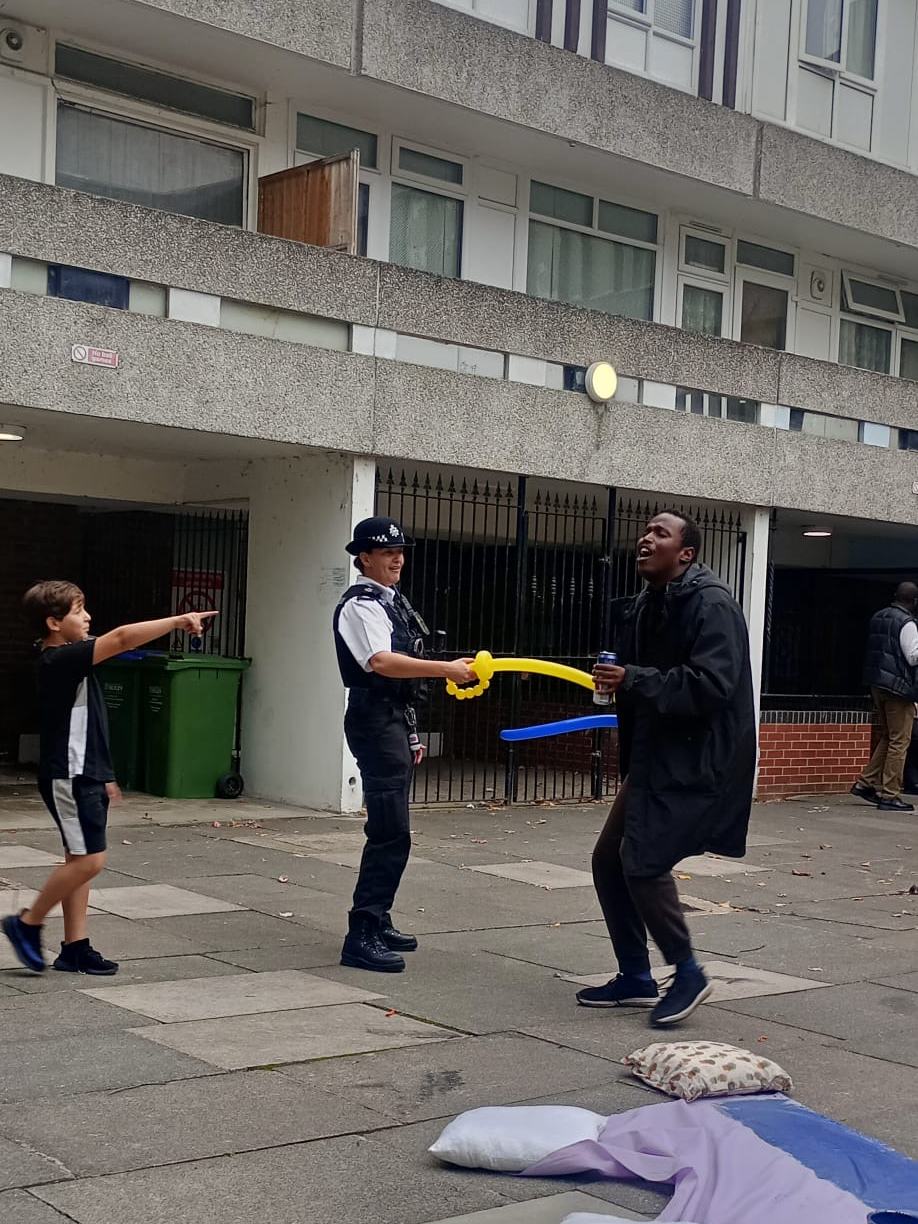
The Housing Demolition Block Party on Saturday 19 September turned the usual script of estate protest upside down. Instead of giving the authorities the confrontation they might expect from a demonstration, the gathering became a celebration of community chaotic, colourful, international and deliberately difficult to categorise.
There were children. There were clowns. There were balloons. There were anarchists. There were people from different generations, backgrounds, genders and religions. As campaigner Lorenzo put it: “The British authorities thought they could destroy the protestival by disarming the protestors with female officers. Little did they know that the anarchists were armed in stealth with Romanian children pumped full of sugar, Italian and French clowns forging balloon swords and Hungarian tech covertly monitoring their movements.
Expecting for there to be hundreds of protesters, they were met with an eclectic small community gathering of international eccentric characters celebrating life across different ages, race, genders and religion.”
It is difficult to imagine a more appropriate response to the sterile language of regeneration documents. The authorities talk about units, development capacity, land value, masterplans and regeneration. The community talks about homes, neighbours, children, memories and belonging. One side sees a site. The other sees a place.
A long-running struggle
Lesnes already has a strange place in popular culture. The estate became internationally recognisable after appearing in Stanley Kubrick’s film A Clockwork Orange.
Peabody Housing Association’s plans would demolish the existing estate and replace it with a development of up to 1,950 homes. The campaign against demolition, under the banner of Lesnes Resistance or LesRes, has been running for years, with residents and supporters demanding that homes are refurbished rather than destroyed.
The campaign has involved protests, occupations of empty properties, legal challenges and other attempts to force the authorities to properly account for what demolition means for residents and the environment.
The dispute over the 2020 residents’ ballot has also been a major part of the campaign.
Although 70.2% of participating residents voted in favour of the regeneration proposal, campaigners and the Mayor’s office raised concerns about how the question was framed and whether residents were adequately told that the proposal involved demolition of their existing homes.
For campaigners, the issue has never simply been whether new homes are needed. It is who gets to decide, who gets displaced, what happens to existing social housing, what happens to the community, and whether demolition is really necessary in the first place. That argument has now reached the High Court.

In July 2026, a judge granted permission for a judicial review of Bexley Council’s decision-making over the redevelopment. The legal challenge concerns, among other things, whether the environmental impact of demolishing the existing estate was properly assessed, including greenhouse gas emissions.
The demolition is therefore not simply a foregone conclusion. The fight continues. And until the last argument has been heard in the courts, in the community and on the streets, Lesnes is not simply a demolition site waiting to happen.
As Lorenzo put it: “As an officer softened with motherly instincts, we exposed their police brutality because fundamentally, as long as you are in uniform with the state authorities and enforcing their corrupt laws, it will always oppose with anarchist values.”
Whether one shares that political conclusion or not, the Block Party demonstrated something that estate regeneration schemes routinely struggle to account for: people are not buildings. You can demolish concrete. You cannot simply demolish a community.
Subscribe to Freedom anarchist journal, sustain radical publishing and support independent media.




Browse over a century of anarchist commentary and reporting from the Freedom digital archive
EXPLORE THE
Archives
Latest

Papuan traditions and Empire’s mess
Models of indigenous governance challenge Western and Indonesian subjugation
New In


Events At
the Bookshop
Freedom Press


Sustain Freedom anarchist journal and contribute to our building fund
SUBSCRIBE
AND DONATE
Source: freedomnews