
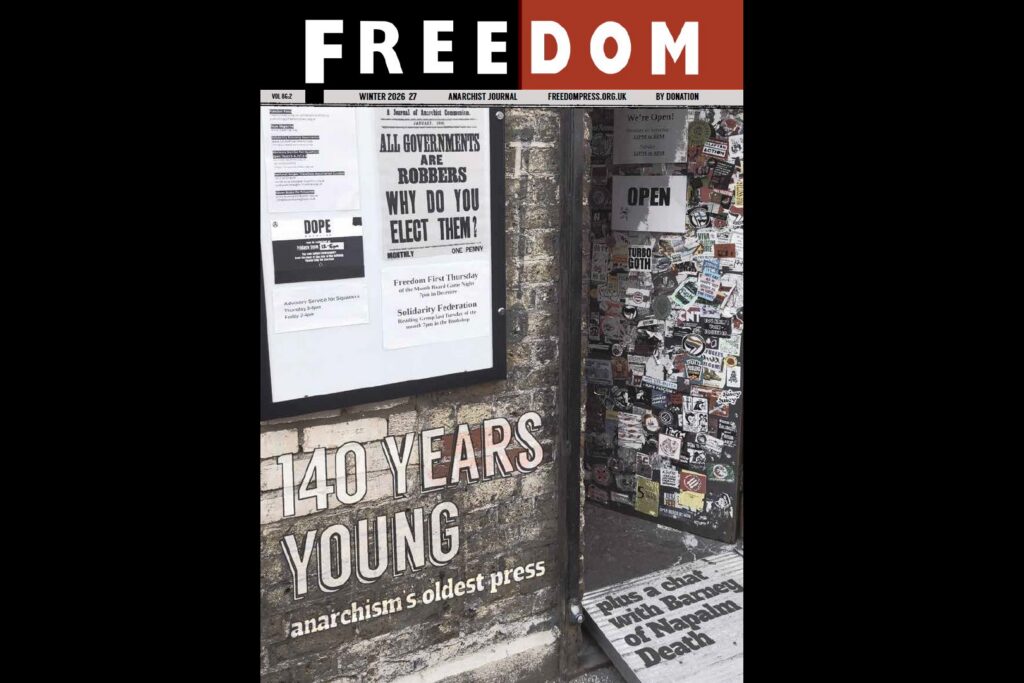
The editorial from our bumper anniversary issue, now in print
~ Freedom News ~
We’ve had a big anniversaries year in 2026. Ninety for the Spanish Civil War, 100 for the General Strike, and for Freedom Press itself, it’s a whopping 140th birthday.
So in this bumper issue we’re exploring some of the themes from across that long haul of radical thinking.
Freedom Press took its first steps in the heady days of the late 19th century, when governments trembled at the thought of anarchist bombs. On the continent kings fell to anarchist gunfire, industries seized up in strikes and riots. Spies swirled around underground bars where liberatory ideologies were passionately debated.
England was, initially, different. Quieter. It was where revolutionaries like Louise Michel fled after the death of the Paris Commune. But with the immigrant reds came bold ideas, and eventually, newspapers.Freedom cannot claim to be the first, even in English. Henry Seymour’s shortlived The Anarchist holds that honour.
But direct from the same milieu came Charlotte Wilson, who recruited the first members of what would become the Freedom Group. Irascible revolutionaries who would rather work out of the back room of a slum tenement than compromise with even the likes of William Morris or Eleanor Marx.
Freedom from the start was a focal point for thought and organisation in the nascent British anarchist movement, which grew in stops and starts through the turn of the century, contributing to the Great Unrest of syndicalism in the pre-war period before being, along with much of the rest of Europe, devastated in World War I.
A much depleted post-WWI movement in Britain was unable to support then publishers Tom Keell and Lilian Wolfe in keeping things going, with the paper going into effective abeyance in the late 1920s-30s until youngsters such as Vernon (Vero) Richards, Marie Louise Berneri, Albert Meltzer, and Philip Sansom came to the fore.
Starting with Spain and The World, where Keell and Wolfe’s presence provided a thread of continuity, the first of a new wave of publications backed the CNT as it fought General Franco, later launching Revolt!, and War Commentary during World War II. It was the likes of Vero, Sansom and Rita Milton who first moved into Angel Alley, Whitechapel, when they took over an old printer during the war, which has ever since been synonymous with London’s anarchists.
They also reset its issues in this period, and from there, despite a brief announcement in 2014 that we were moving online, we have managed to bring out issues every year since. Hence our current volume number.
We have had editors jailed (the raids of 1916, the infamous War Commentary trial of 1945), our premises attacked (bombed by Nazis, ransacked by coppers, attacked by fascists) and, occasionally, we’ve fought amongst ourselves, but the Collective still stands, and even manages to regularly produce journals, journalism – and of course, make and sell books.
In issue 86:2—articles from which will be posted online over the coming months—writers address, for the most part, that post-WWII incarnation of Freedom. Sophie Scott Brown considers ambition, Ole Birk Laursen internationalism, Erik Laursen inclusion, Ruth Kinna flexibility, and Rob Ray resilience.
Elsewhere in the journal, Daniel Adediran offers an optimistic note on direct action in Britain – it ain’t dead by a stretch; Uri Gordon talks to vocalist Barney Greenway about his life, times and experience with anarcho-punk legends Napalm Death; and Danny Evans hails the spirit of revolutionary Spain in 1936.
The post 140 years young—anarchism’s oldest press appeared first on Freedom News.
Source: freedomnews